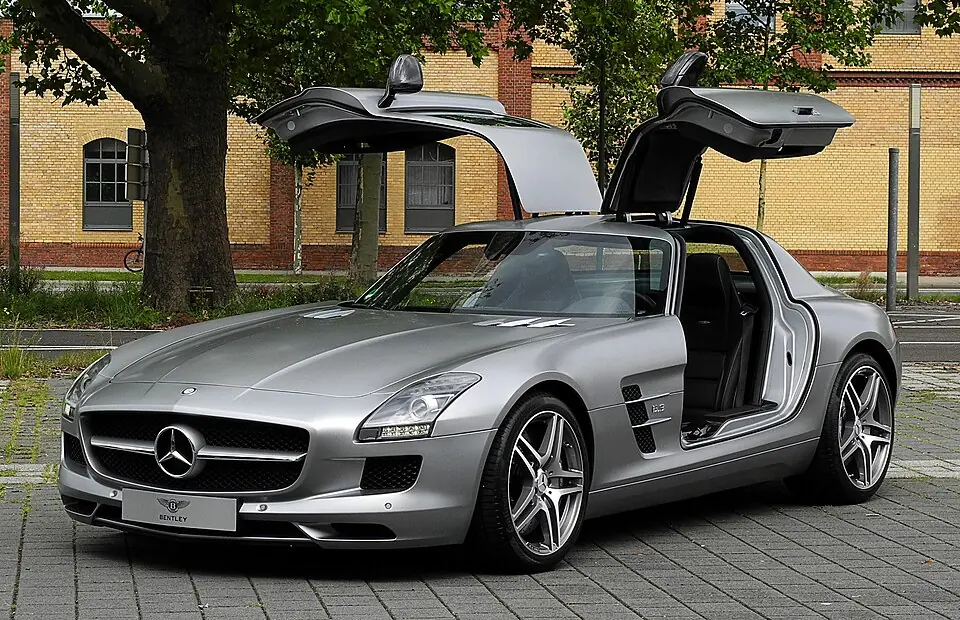
Mercedes-Benz SLS AMG
Why 4.5: The last fully AMG-developed car of its era: dry-sump 6.2, rear transaxle, doors that are pure showmanship bolted to a genuinely serious chassis. Half the buyers came for the doors; values now reward both halves.
Layout
Natural habitat
Ride comfort
Sound
The hand-built M159 6.2 is the C63's naturally aspirated V8 with a lighter flywheel and a freer exhaust that cracks hard on downshifts. It is capped by 7,200 rpm and a cross-plane bark that never develops. Above the C63 saloon, short of the Porsche flat-sixes.
8-cylinder · naturally aspirated · 7,200 rpm redline · rated 8.2 / 10 for engine sound
Market value
Median asking price, good condition · €175k (2011) → €239k (2026), trending up · illustrative data
Child seats · ISOFIX
There aren't any — strict two-seater.
No ISOFIX up front, consistent with every other Mercedes 2-seater of this era — whether the SLS also picked up AKSE transponder recognition like the contemporary SL and SLK isn't documented anywhere confirmable.
Gullwing doors and a carbon transmission tunnel make this a moot question in practice.
Mercedes front-passenger ISOFIX pattern — no 2000s–2010s Mercedes 2-seat sports car (SL, SLK, SLR, AMG GT) turned up with front ISOFIX (owner-community sourced, not manufacturer documentation)
The long version
The gullwing novelty wore off around the same time values bottomed out in the mid-2010s, which is when the SLS quietly became a used car instead of an event car — bought by people who wanted the AMG V8 and transaxle balance and could live with doors that make every parking garage a production. Recent appreciation has not scared that buyer off; club drives and road-trip posts still outnumber static show entries. It never built the flipper mythology of its gullwing ancestor, mostly because nobody needed a reason to drive one.