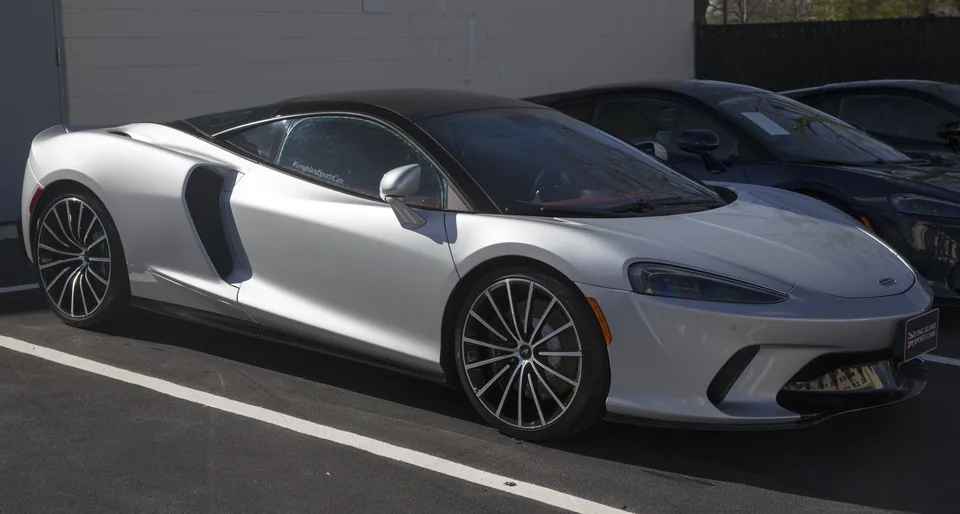
McLaren GT
Why 5.9: Softer dampers, more sound insulation, and 570 liters of front-and-rear luggage space — McLaren built the GT to be the one car in its lineup buyers could actually use every day, and depreciation followed a normal exotic-GT curve rather than the McLaren-specific cliff. The least track-focused McLaren here may be the most-driven one.
Layout
Natural habitat
Ride comfort
Sound
There is a distant twin-turbo V8 hum and a light crackle if you provoke it. But McLaren deliberately tuned and insulated this one for touring, so the least interesting version of an already flat engine ends up among the quietest combustion cars rated here.
8-cylinder · turbocharged · 7,500 rpm redline · rated 5.2 / 10 for engine sound
Market value
Median asking price, good condition · €199k (2020) → €133k (2026), trending down · illustrative data
Child seats · ISOFIX
There aren't any — strict two-seater.
No ISOFIX despite the grand-touring brief — same occupant-sensing passenger airbag deactivation as the rest of the range.
McLaren Owner's Handbook (shared Sports/Super Series platform) (owner-community sourced, not manufacturer documentation)
The long version
Every other McLaren in this index is calibrated toward the same thing: a lighter, sharper, more track-capable version of the last one. The GT deliberately isn't. Same basic carbon tub and twin-turbo V8 architecture as the Sports and Super Series cars, but softened dampers, extra sound deadening, and real cargo space front and rear specifically so it can replace a daily driver instead of supplementing one. McLaren discontinued it in 2023 in favor of the GTS, but while it was in production it depreciated more gently than McLaren's reputation would predict — the exotic-GT segment overall loses roughly 30% of its value in five years, and the GT tracked close to that norm rather than the steeper cliff that hit the 650S and 12C. That is the whole point of the car: buyers who wanted a McLaren they could actually live with, not one that could lap a track a few seconds faster.