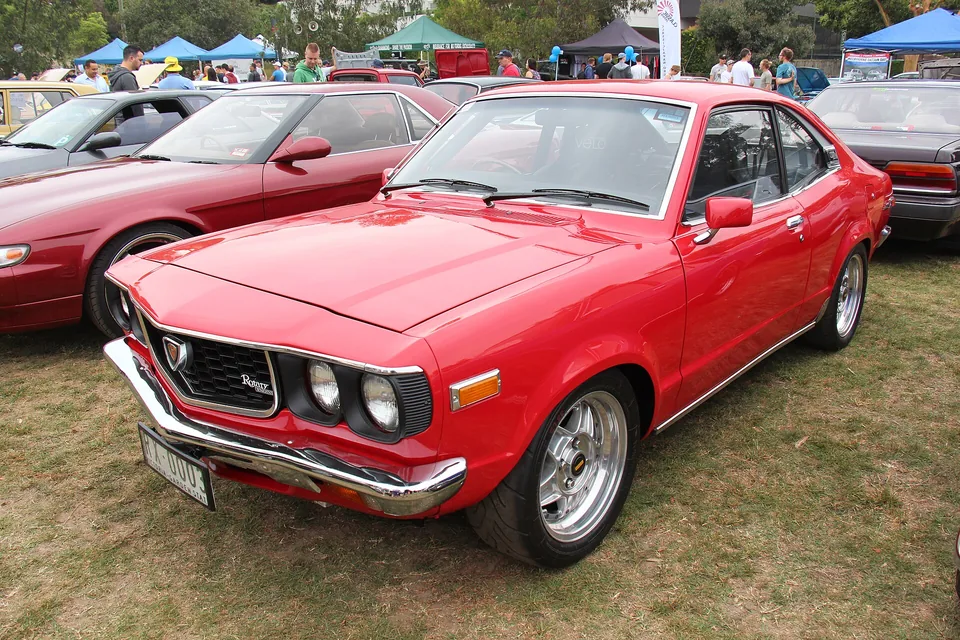
Mazda RX-3
Why 4.5: Underneath is the Grand Familia, an entirely ordinary early-1970s Mazda. In RX-3 form that shell got a twin-rotor Wankel that spun to 7,000 rpm and weighed almost nothing over the front axle, and it won touring car races against cars with far bigger reputations. Values have since gone the way that story always sends them, which is why the miles have stopped.
Layout
Natural habitat
Ride comfort
Sound
A carburetted 12A has no reciprocating pulse at all — a hard, even, metallic tearing note that rises without steps — and there is barely any 1973 silencing in the way of it. But it stops at 7,000 rpm rather than the Renesis’ 9,000, and the cruising drone is tiring. The rotary at its rawest.
2-cylinder · rotary · 7,000 rpm redline · rated 7.2 / 10 for engine sound
Market value
Median asking price, good condition · €3k (1973) → €53k (2026), trending up · illustrative data
Child seats · ISOFIX
Built before ISOFIX existed, so there are no anchor points at all. A child seat here is a seatbelt installation, and the belt geometry of the period was not designed with one in mind.
Derived from production years and seating layout, not a per-car source. ISOFIX was standardised as ISO 13216 in 1997, required on new EU model types from 2011 and on all new EU cars from 2014.
The long version
Mazda’s rotary programme in the early 1970s was not a halo exercise. The company put the engine in almost everything it made and expected to sell it in volume, and the RX-3 — Savanna, in Japan — was the sharp end of that plan. It is a Grand Familia bodyshell offered as a coupé, a saloon and an estate, with a 982 cc 10A twin-rotor at launch and the larger 12A from 1972, weighing about 950 kg because a Wankel is a physically small engine. In Japanese touring car racing that combination did what nobody had managed. At the Fuji Tourist Trophy in December 1971 a Savanna beat the Nissan Skyline GT-R, ending a forty-nine-race winning streak and denying Nissan the fiftieth win it had been advertising in advance. The Savanna then kept winning for five more years. In Australia and New Zealand the RX-3 became a club-racing and drag-strip staple for thirty years, which is where most of them died. Then the 1973 oil crisis arrived, a rotary’s fuel consumption turned from footnote into headline, and Mazda spent the rest of the decade close to collapse. What survived is now scarce and expensive — clean coupés change hands for sums that would buy a new performance car, and the Australian market in particular has run hard. That is what pushes the ownership numbers here down. These are restored cars now, driven on Sundays and trailered to shows, not the cheap street weapons they were for most of their lives.