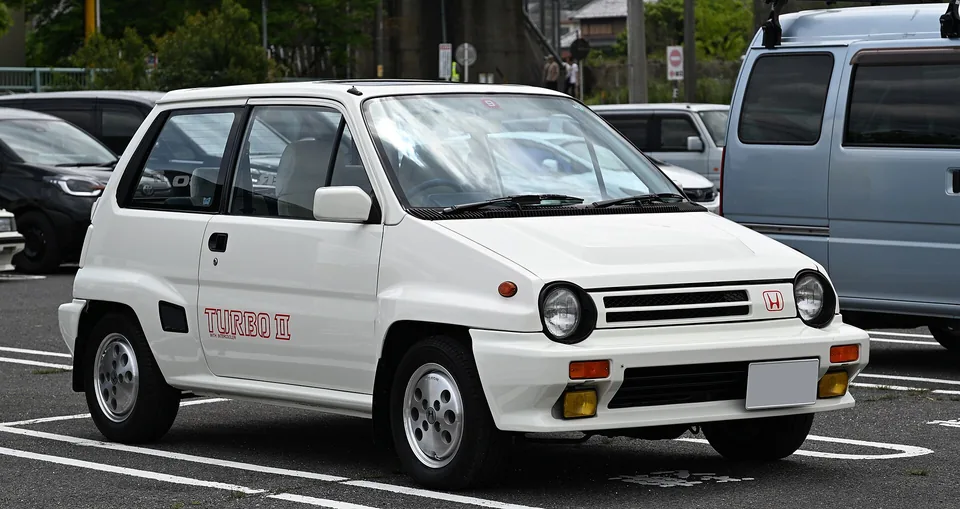
Honda City Turbo II
Why 6.5: Honda took a 3.4-metre tall-boy city car, hung an IHI turbocharger and an intercooler on its 1.2-litre single-cam four for 110 PS, then widened the arches to cover the track it now needed. At 735 kg that is about 150 PS per tonne, in 1983, in a car short enough to park sideways in a normal space.
Layout
Natural habitat
Ride comfort
Sound
An IHI turbo and an intercooler on a 1.2 make a whistle wildly out of scale with the car, and there is almost nothing in 735 kg of Honda to absorb it. But the ER is a single-cam eight-valve economy four with no top end of its own, so the theatre is all turbocharger. Comedy rather than music.
4-cylinder · turbocharged · 6,000 rpm redline · rated 5.4 / 10 for engine sound
Market value
Median asking price, good condition · €6k (1984) → €17k (2026), trending up · illustrative data
Child seats · ISOFIX
Built before ISOFIX existed, so there are no anchor points at all. A child seat here is a seatbelt installation, and the belt geometry of the period was not designed with one in mind.
Derived from production years and seating layout, not a per-car source. ISOFIX was standardised as ISO 13216 in 1997, required on new EU model types from 2011 and on all new EU cars from 2014.
The long version
The first-generation City is one of Honda’s strangest good ideas: a car designed upward rather than outward, 3,380 mm long and tall enough to sit in properly, launched in 1981 behind an advertising campaign built around a dance. The Turbo followed in 1982 with 100 PS. The Turbo II, from November 1983, is the one that stopped being a novelty — Honda added an intercooler for 110 PS, then fitted flared arches, a bulging bonnet and deeper bumpers, and the shape earned the car its nickname, Bulldog, and a following that has never faded. The Motocompo is the detail everyone repeats: a 49 cc scooter with folding bars and seat, sized to exactly fill the City’s boot so the car could carry its own last mile. It is worth knowing that Honda stopped building the Motocompo in 1983, so the pairing with the Turbo II barely happened at all; the scooter really belongs to the naturally aspirated cars that came before. What the Turbo II has instead is the mechanical package, and that has aged extremely well. It was a Japanese proposition only, never sold new in North America, so every one outside Japan was imported deliberately by somebody who wanted this exact car. They are small enough and cheap enough to keep, which is why more of them get used than a rising market would suggest — but the market is rising, and the show cars are starting to outnumber the driven ones.