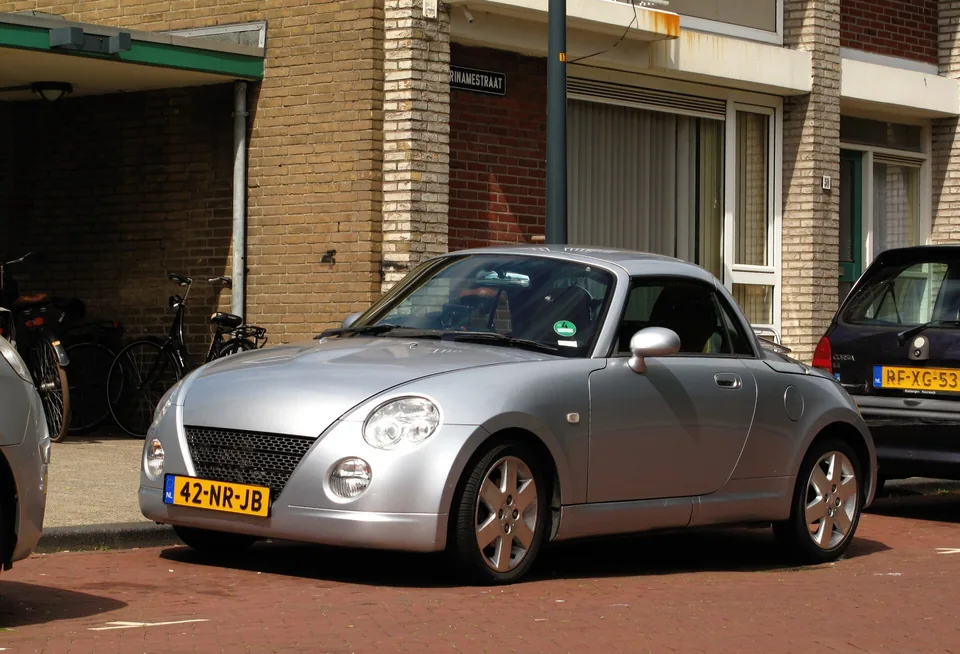
Daihatsu Copen
Why 8.2: Kei rules handed Daihatsu 3,395 mm, 660 cc and, by agreement between the manufacturers, 64 PS. It spent the money on an electrically folding two-piece metal hardtop and on a four-cylinder engine where every rival used a three — both expensive, neither visible on a spec sheet. The result is the most usable of the kei roadsters and the one people genuinely daily.
Layout
Natural habitat
Ride comfort
Sound
Four cylinders instead of the usual kei triple make the JB-DET much the smoothest 660 here, with none of the offbeat thrum an Alto Works or an AZ-1 trades on. Smooth is the problem: Daihatsu wanted a civilised roadster and silenced it to match, so there is turbo whistle and little else. The quietest kei car here, on purpose.
4-cylinder · turbocharged · 7,000 rpm redline · rated 4.8 / 10 for engine sound
Market value
Median asking price, good condition · €14k (2004) → €12k (2026), trending down · illustrative data
Child seats · ISOFIX
There aren't any — strict two-seater.
The only position there is — and the weak point of this era. Airbag cut-off switches only became routine in the mid-2000s; many of these cars have none from the factory, which rules out a rear-facing seat entirely unless a dealer-fitted deactivation was installed. Forward-facing on the belt, seat slid fully back, is what the period manuals allow.
Derived from production years and seating layout, not a per-car source. ISOFIX was standardised as ISO 13216 in 1997, required on new EU model types from 2011 and on all new EU cars from 2014.
The long version
Every kei roadster in this index is a compromise made interesting. The Copen is the one that tried to remove the compromise instead. Where the Beat has a fabric roof and the Cappuccino a set of panels to stow by hand, the Copen carries a two-piece metal roof that folds itself into the boot electrically in about twenty seconds, so it is a coupé in February and a convertible in July without anybody getting out. Where almost every other 660 cc engine in Japan is a three-cylinder, the JB-DET is a sixteen-valve twin-cam four with a turbocharger — smoother than any triple and capped at exactly the same 64 PS everyone else made, which tells you it was built for refinement rather than the number. And it was sold properly: decently trimmed, and distributed across Europe through real dealer networks rather than importers — first with the kei turbo, then from October 2007 with an 87 PS 1.3 in the markets where the little engine could no longer meet emissions rules. That is the whole ownership case. It is a tiny sports car you can live with, it cost about what a supermini cost, and it has never been valuable enough to store. Values bottomed out and are only now creeping back as the L880K becomes the collectable one, but these are still cars bought to be used, and the odometers reflect that better than almost anything else here.