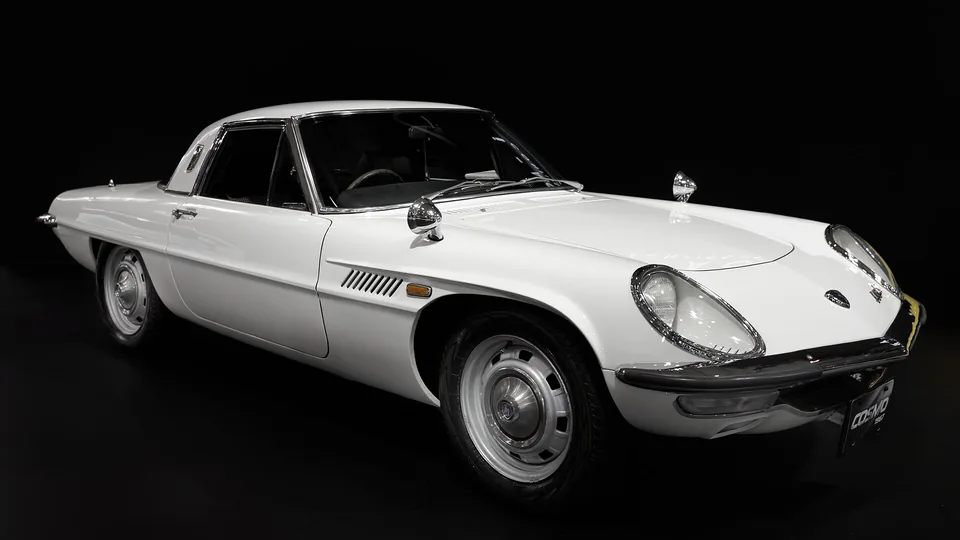
Mazda Cosmo Sport 110S
Why 2.3: NSU reached the market first with a single-rotor Wankel; Mazda got a two-rotor engine to survive being used, which is the version everyone else spent the following decade failing to build. The 110S weighs 940 kg, has a de Dion rear axle and revs to 7,000 rpm, and 1,176 of them exist. That last number settles the ownership picture on its own.
Layout
Natural habitat
Ride comfort
Sound
The 10A is 982 cc split between two rotors and rises to 7,000 rpm as one continuous smooth tearing note, with no firing pulse to count and nothing else from 1967 remotely like it. But it is a small engine making a light, high sound, trimmed to be pleasant rather than loud. Historic more than thrilling.
2-cylinder · rotary · 7,000 rpm redline · rated 7.0 / 10 for engine sound
Market value
Median asking price, good condition · €4k (1967) → €170k (2026), trending up · illustrative data
Child seats · ISOFIX
Built before ISOFIX existed, so there are no anchor points at all. A child seat here is a seatbelt installation in the only passenger seat there is.
Derived from production years and seating layout, not a per-car source. ISOFIX was standardised as ISO 13216 in 1997, required on new EU model types from 2011 and on all new EU cars from 2014.
The long version
Mazda licensed the Wankel from NSU in 1961 with a few dozen engineers and a problem nobody had solved: under sustained load the apex seals scored the rotor housings into a pattern the team named chatter marks, and the engine ate itself. The fix was carbon-aluminium seals and years of testing, and the car built to prove it worked was the Cosmo Sport. It went on sale in May 1967 — low, narrow, largely hand-finished, with a 982 cc two-rotor 10A making 110 PS at 7,000 rpm, which is where the 110S name comes from. From July 1968 the Series II added a five-speed gearbox, 128 PS and 150 mm of wheelbase. Mazda entered two of them in the 1968 Marathon de la Route, eighty-four hours around the Nürburgring, largely to answer the durability question in public; one finished fourth. Total production across five years was 1,176 cars, and that figure governs everything about them now. They were never officially sold in America, they are the founding object of the entire rotary story, and clean ones are museum property at museum prices. Nobody drives a Cosmo Sport anywhere in particular. That is not a criticism of the car — it is what happens to something this rare, and the score here measures the fate rather than the machine.