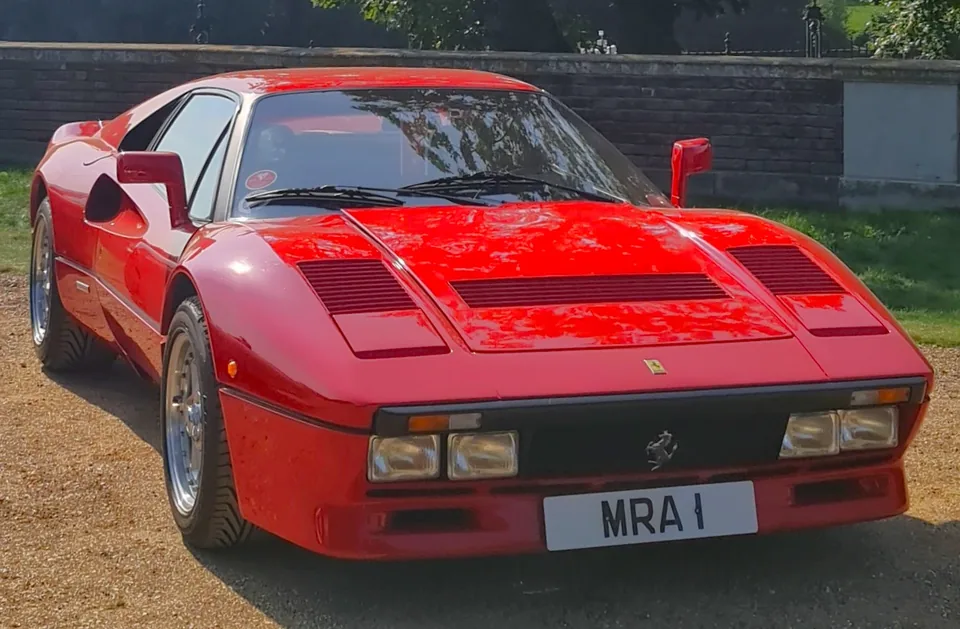
Ferrari 288 GTO
Why 3.0: Ferrari needed 200 road cars to enter Group B, built 272, and then watched the FIA abolish the category before the racing version turned a competitive lap. What was left is the first modern Ferrari halo car and the direct ancestor of the F40 — and it was priced accordingly almost immediately, which is what took it off the road.
Layout
Natural habitat
Ride comfort
Sound
Two IHI turbos on a 2.9 V8 mounted lengthways behind the bulkhead, so induction roar and wastegate chatter reach you directly, and it still climbs to 7,800 rpm. But those turbos sit in the exhaust path and smother the top octave the barely-silenced F40 later found. Ferrari's most civilised twin-turbo, and that is the cost.
8-cylinder · turbocharged · 7,800 rpm redline · rated 8.2 / 10 for engine sound
Market value
Median asking price, good condition · €76k (1985) → €3.2M (2026), trending up · illustrative data
Child seats · ISOFIX
Built before ISOFIX existed, so there are no anchor points at all. A child seat here is a seatbelt installation in the only passenger seat there is.
Derived from production years and seating layout, not a per-car source. ISOFIX was standardised as ISO 13216 in 1997, required on new EU model types from 2011 and on all new EU cars from 2014.
The long version
The 288 GTO looks like a 308 and shares very little with one. The wheelbase is 110 mm longer, because Ferrari rotated the V8 from transverse to longitudinal to fit two IHI turbochargers and their intercoolers behind the cabin, and the body over that is Kevlar and glassfibre rather than steel. It made 400 PS from 2,855 cc — a capacity chosen so that Group B's 1.4 turbo equivalency factor put it exactly under the four-litre class ceiling — and weighed 1,160 kg dry. Then Group B was abolished for 1987 after two seasons of fatalities, the five Evoluzione cars built to race it had nowhere to go, and the 272 customer GTOs became something nobody had planned: the first Ferrari bought principally because there would not be many of them. That happened fast. Values tripled inside the 1989–90 speculative bubble, collapsed with it, and have since climbed well past anything the original buyers imagined. None of that produces mileage. A 288 GTO now is a stored asset with a service history and a transport company on file, moved a few hundred miles a year at most, and the handful of owners who genuinely use theirs are conspicuous precisely because they are unusual. It scores where it does because of what happened to the cars, not what the car does.