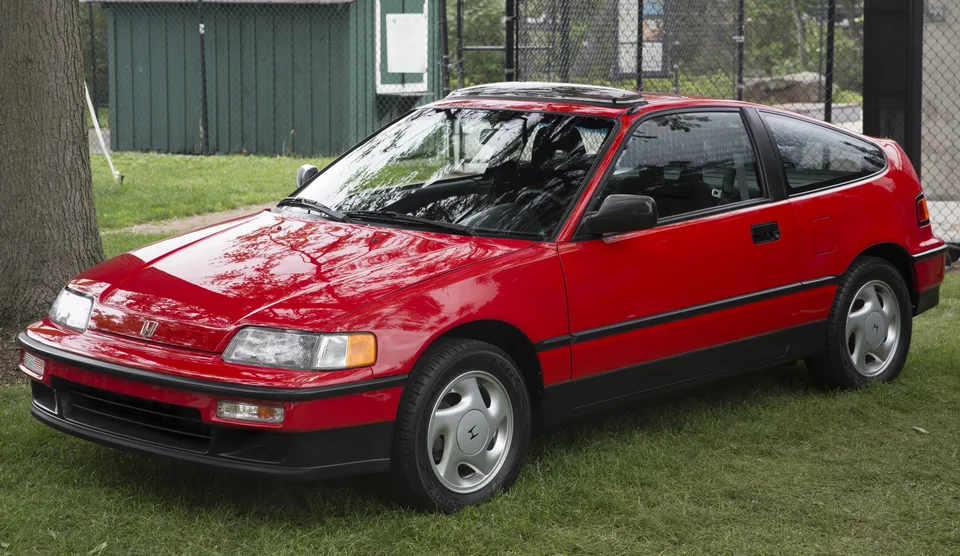
Honda CR-X Si
Why 6.8: Under 2,100 lbs, a genuinely good 5-speed and unassisted steering made this the autocross-and-track default for a generation of Honda owners who bought it specifically to use up. Prices sat near nothing for three decades because the ones that survived driving hard were the ones people wanted — that's inverting fast: clean survivors jumped roughly 90% in a single year, and the driving is starting to lose to the garage.
Layout
Natural habitat
Ride comfort
Sound
The D16A6 gets keen and buzzy near its 6,800 rpm limit, helped by how little car there is to muffle it. But this is the single-cam Si rather than the VTEC SiR, so there is no second cam profile and no change of character — pleasant, and nothing more.
4-cylinder · naturally aspirated · 6,800 rpm redline · rated 4.8 / 10 for engine sound
Market value
Median asking price, good condition · €10k (1988) → €51k (2026), trending up · illustrative data
Child seats · ISOFIX
Built before ISOFIX existed, so there are no anchor points at all. A child seat here is a seatbelt installation in the only passenger seat there is.
Derived from production years and seating layout, not a per-car source. ISOFIX was standardised as ISO 13216 in 1997, required on new EU model types from 2011 and on all new EU cars from 2014.
The long version
Honda built this as the sporty end of the Civic line, a two-seat (plus a pair of token rear jump seats) liftback wrapped around the D16A6, a modest 105-to-108-hp SOHC four that nobody would call fast on paper but that felt genuinely alive in a car weighing barely more than 2,000 pounds. That combination — light, cheap, honestly good chassis balance, unassisted steering — turned it into the default answer for a generation of budget racers and autocrossers who bought it specifically to abuse it, and abuse it they did; three decades of hard use and amateur racing thinned the unmolested-survivor population dramatically. For most of that time values reflected exactly that: this was used-hatchback money, no different from any other cheap 90s Honda, and the ownership pattern was purely about driving. That's changed with startling speed very recently — good-condition 1988 cars roughly doubled in a single year through 2024, and spotless survivors that traded around $37,000 in 2024 were pushing $70,000 within twelve months, a record sale hitting $71,500 in early 2025. The reason is survivorship: decades of the exact hard use that made this fun to own also made clean original examples genuinely rare, and the market has only just noticed. The autocross culture hasn't disappeared, but the newest buyers increasingly aren't the ones showing up to use it that way.