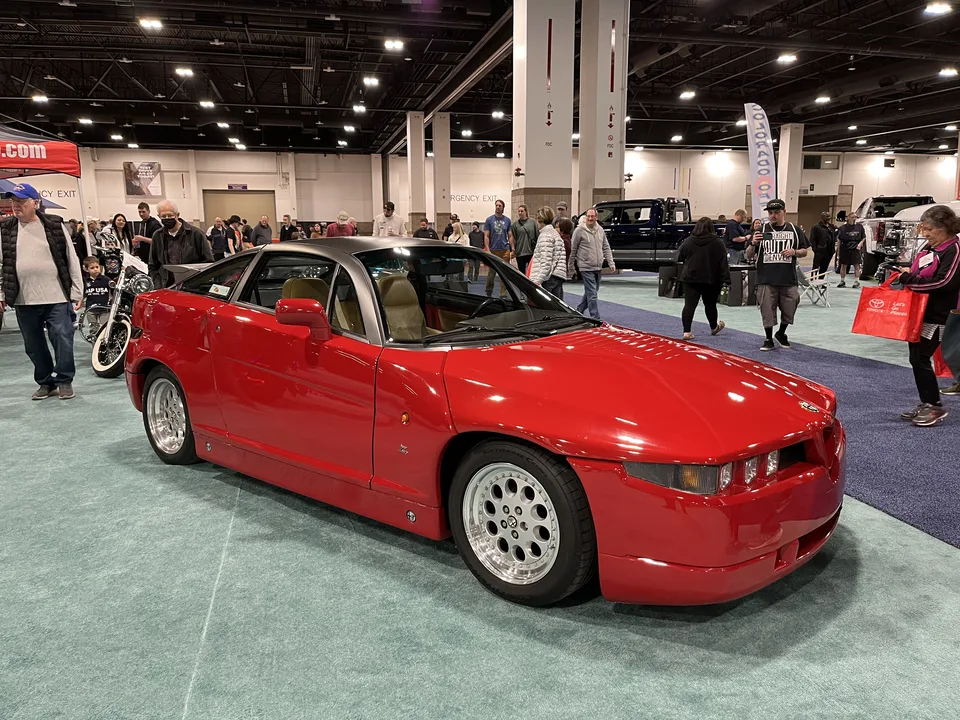
Alfa Romeo SZ
Why 3.8: Zagato wrapped a genuinely sharp rear-transaxle chassis — inherited from the Alfa 75's Group A racer — in thermoplastic bodywork so polarizing the press nicknamed it 'Il Mostro' at launch. Never sold new in the US, and only 1,036 built, but the design that divided people in 1989 is exactly what collectors are chasing now that Alfa has revived the Zagato partnership.
Layout
Natural habitat
Ride comfort
Sound
The 3.0 Busso runs to 6,800 through a freer exhaust, so it finishes the crescendo the 5,600 rpm GTV6 always had to cut short. But it is still a twelve-valve V6 with one cam per bank, which is why it edges past the GTV6 rather than leaving it behind.
6-cylinder · naturally aspirated · 6,800 rpm redline · rated 8.4 / 10 for engine sound
Market value
Median asking price, good condition · €53k (1989) → €78k (2026), trending up · illustrative data
Child seats · ISOFIX
Built before ISOFIX existed, so there are no anchor points at all. A child seat here is a seatbelt installation, and the belt geometry of the period was not designed with one in mind.
Derived from production years and seating layout, not a per-car source. ISOFIX was standardised as ISO 13216 in 1997, required on new EU model types from 2011 and on all new EU cars from 2014.
The long version
The styling brief here wasn't 'pretty' — it was 'unmistakable,' and Zagato delivered a body so aggressively creased that period reviewers reached for 'monster' as a compliment and an insult simultaneously, which is where 'Il Mostro' comes from. Underneath the controversial thermoplastic panels is a genuinely serious chassis: the rear-mounted transaxle gearbox and De Dion suspension come straight from the Alfa 75's Group A touring-car program, giving this the same near-50/50 weight distribution that made the 75 a good racer, wrapped around a 3.0-liter Busso V6 that most Alfa enthusiasts rate among the best-sounding engines the company ever built. Alfa never sold it new in the US — the brand had all but retreated from the American market by the time production ended in 1991 — so every US car arrived as a private grey-market import, and Alfa built only 1,036 to begin with. For a long stretch that combination of weird looks and total US unavailability kept prices modest, the kind of money that bought genuine enthusiasts rather than investors. That's shifted recently: Alfa's own revival of the Zagato partnership for a modern Giulia-based coupe put the original SZ back in front of collectors, and prices have climbed accordingly, pulling a design people voted against in 1989 toward the vault.