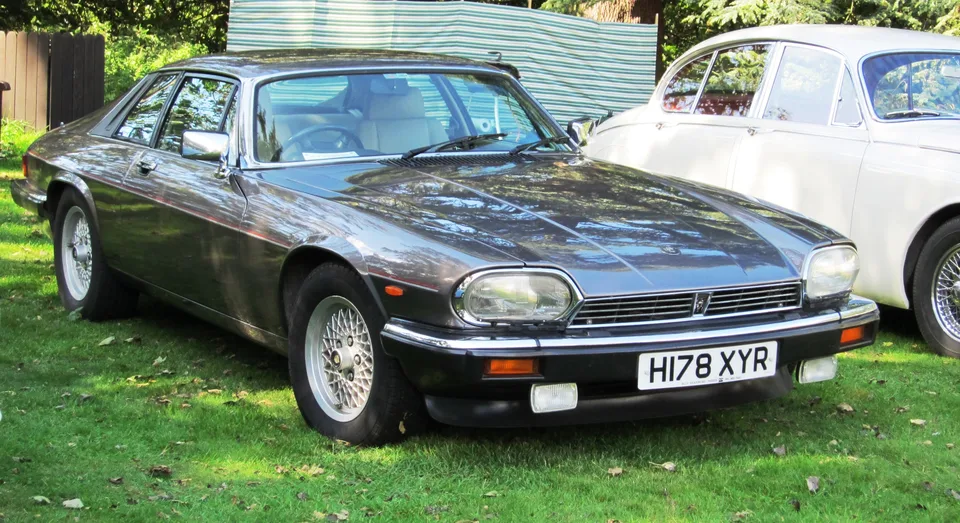
Jaguar XJ-S V12
Why 5.0: A V12 GT that Jaguar kept in production for 21 unbroken years and 115,413 units, mostly sold with a 3-speed automatic built for silence over drama. It remains one of the cheapest ways into a 12-cylinder car on the planet, and the reason is the reason: Lucas electrics and V12 cooling-system bills that can outrun the car's own resale value scare owners off before they've put many miles on it.
Layout
Natural habitat
Ride comfort
Sound
Twelve cylinders that Jaguar tuned for silence: a distant hum at cruise, and a soft layered yowl rather than a hard edge at full throttle. It is capped by the very refinement it was built for, which leaves more cylinders here than sound.
12-cylinder · naturally aspirated · 6,500 rpm redline · rated 5.9 / 10 for engine sound
Market value
Median asking price, good condition · €26k (1975) → €11k (2026), trending down · illustrative data
Child seats · ISOFIX
Built before ISOFIX existed, so there are no anchor points at all. A child seat here is a seatbelt installation, and the belt geometry of the period was not designed with one in mind.
Derived from production years and seating layout, not a per-car source. ISOFIX was standardised as ISO 13216 in 1997, required on new EU model types from 2011 and on all new EU cars from 2014.
The long version
Jaguar handed this the impossible job of following the E-Type and, by most contemporary accounts, lost that argument at launch — the flying-buttress rear pillars and the absence of anything resembling the E-Type's nose drew genuine backlash in 1975, and it took most of a decade for the car to be judged on its own terms rather than against its predecessor's ghost. What it actually delivered was a different kind of car entirely: a 5.3-liter V12 tuned for the smoothness and silence Jaguar's own period advertising leaned on, mated to a 3-speed automatic for nearly the entire run — a 4-speed manual existed from 1975 to 1979 but almost nobody ordered one. The 1981 'HE' update, using Michael May's Fireball combustion chamber design, fixed the early cars' genuinely alarming fuel consumption without touching the character, and Jaguar kept building it for 21 unbroken years and 115,413 units. None of that production volume translated into value: this remains one of the cheapest routes into a 12-cylinder grand tourer that exists, average-condition convertibles trading in the low five figures, because the ownership reality is well understood — Lucas electrical gremlins, chronic underhood heat problems, and V12 parts bills that can exceed the car's own worth have scared off exactly the casual buyers who'd otherwise put real miles on it. The cars that survive tend to be owned either by V12 specialists who know precisely what they're doing, or by someone two years into finding out the hard way.