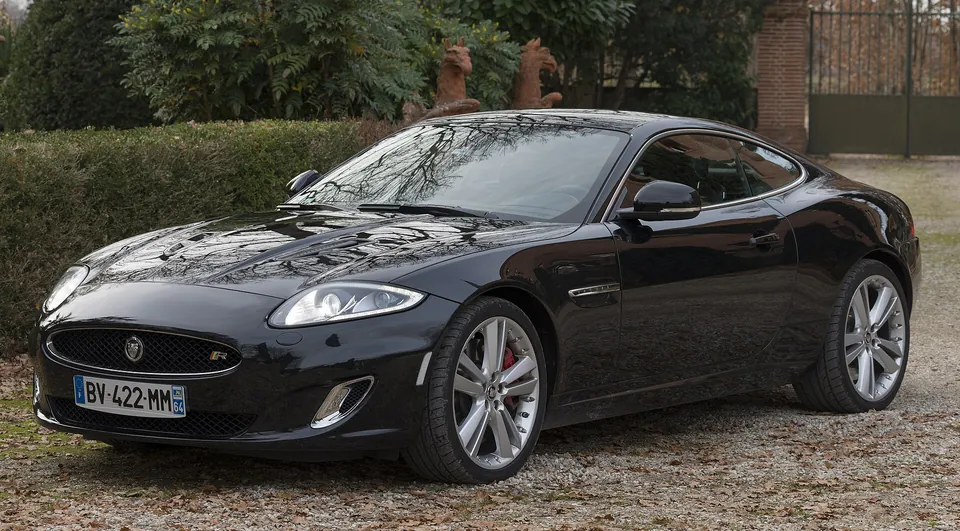
Jaguar XKR (X150)
Why 7.3: Ian Callum's aluminium-bodied XK in supercharged form: 416 PS from the 4.2 at launch, 510 PS from the 5.0 after the 2009 facelift, always through a six-speed ZF automatic. Jaguar built 27,612 X150s and depreciation has been merciless, which is exactly why the surviving owners drive them — this is now a supercharged V8 grand tourer at used-family-car money.
Layout
Natural habitat
Ride comfort
Sound
The supercharged AJ-V8 brings the same blower whine and V8 bass as the F-Type, and there is real weight to it. It is capped by GT insulation and, on most cars, no active exhaust valve, so it stays a background rumble where the F-Type performs.
8-cylinder · supercharged · 6,500 rpm redline · rated 6.8 / 10 for engine sound
Market value
Median asking price, good condition · €89k (2010) → €28k (2026), trending down · illustrative data
Child seats · ISOFIX
Two ISOFIX positions on the outer rear seats — jump seats, so the question is whether the seat physically fits behind a front occupant, not whether the anchors are there.
The rear anchors are the supported route — the manual points child seats there, and front-passenger ISOFIX is the exception rather than the rule. A belt-mounted seat up front needs the airbag off, and cars with a rear row don't always fit a deactivation switch, precisely because the rear seats exist.
Derived from production years and seating layout, not a per-car source. ISOFIX was standardised as ISO 13216 in 1997, required on new EU model types from 2011 and on all new EU cars from 2014.
The long version
Jaguar built the X150 on a bonded and riveted aluminium structure, the same thinking that underpinned the contemporary XJ, and Callum's shape did enough work that the car outlasted its own mechanical generation — 27,612 built from 2005 until production ended in July 2014 with no direct replacement, the F-Type taking over the role afterwards. The XKR is the supercharged half of that range: 4.2 litres and 416 PS through 2008, then the AJ-V8 Gen III 5.0 and 510 PS from the 2009 facelift onward, driving the rear wheels through a ZF 6HP26 automatic. No manual was ever offered, which quietly settled what kind of car this is — a long-legged GT rather than a back-road scalpel — and the ownership pattern followed the hardware. Values then fell hard and kept falling: a car that listed close to six figures now trades for the price of a well-specified family hatchback, which handed the model to a second generation of owners who bought specifically because a supercharged V8 Jaguar had become affordable. Those owners commute in them, tour in them and put real mileage on them, which is not something you can say about the rarer XKR-S sitting alongside it on this index. Same body, same engine family, very different reasons for buying — and the gap between the two scores is the point.