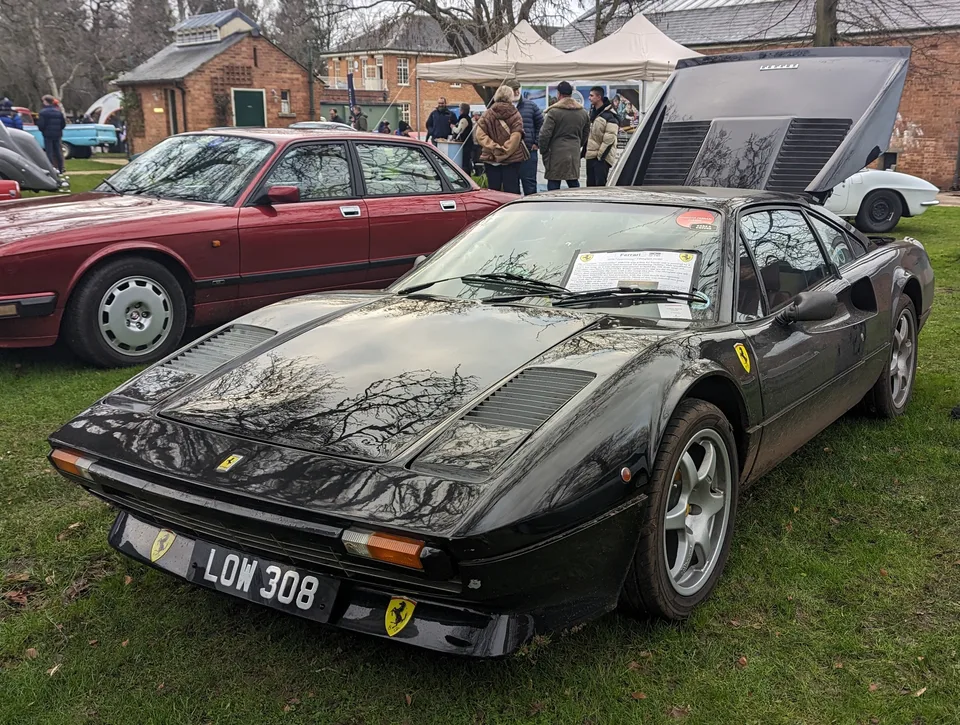
Ferrari 308 GTB
Why 4.8: Ferrari's first fiberglass-bodied production car and the direct ancestor of every mid-V8 Ferrari since — 2,897 built, more than triple the Dino it replaced. Values have climbed steadily rather than spiked, and Hagerty still calls it 'increasingly affordable' relative to the rest of the lineup, which tracks with an ownership base that buys it to drive rather than to flip.
Layout
Natural habitat
Ride comfort
Sound
Ferrari's first flat-plane road V8, breathing through four Weber carburettors and revving to 7,700 with only a thin bulkhead in the way. But 2.9 litres limits the weight behind the wail, which keeps it below the 458 Speciale rather than beside it.
8-cylinder · naturally aspirated · 7,700 rpm redline · rated 8.7 / 10 for engine sound
Market value
Median asking price, good condition · €28k (1976) → €152k (2026), trending up · illustrative data
Child seats · ISOFIX
Built before ISOFIX existed, so there are no anchor points at all. A child seat here is a seatbelt installation in the only passenger seat there is.
Derived from production years and seating layout, not a per-car source. ISOFIX was standardised as ISO 13216 in 1997, required on new EU model types from 2011 and on all new EU cars from 2014.
The long version
This replaced the Dino 246 and inherited its transverse mid-engine layout, but wore a Ferrari badge on the nose for the first time and launched with a fiberglass body — Vetroresina, in period parlance — that Ferrari abandoned for steel within two years once quality problems in the resin panels became a factory headache. Only 712 of the fiberglass cars left the factory before the switch, which now makes them the specialist's pick within the GTB itself. US cars got a wet-sump, 240-hp detune for emissions; European carbureted cars kept the dry-sump 255-hp spec and a genuinely quicker throttle response. The 308 went on to become Ferrari's best-selling model to date, a title it held until the 360 arrived in the 1990s, and that production volume — 2,897 GTBs against roughly 800 Dino 246 GTs — has kept it out of untouchable territory even as prices climb. Hagerty's own coverage frames it as 'increasingly affordable' rather than speculative, and the ownership pattern backs that up: this is bought by people who want the gated shifter and the V8 note on a Sunday drive, not people protecting a number on a spreadsheet.