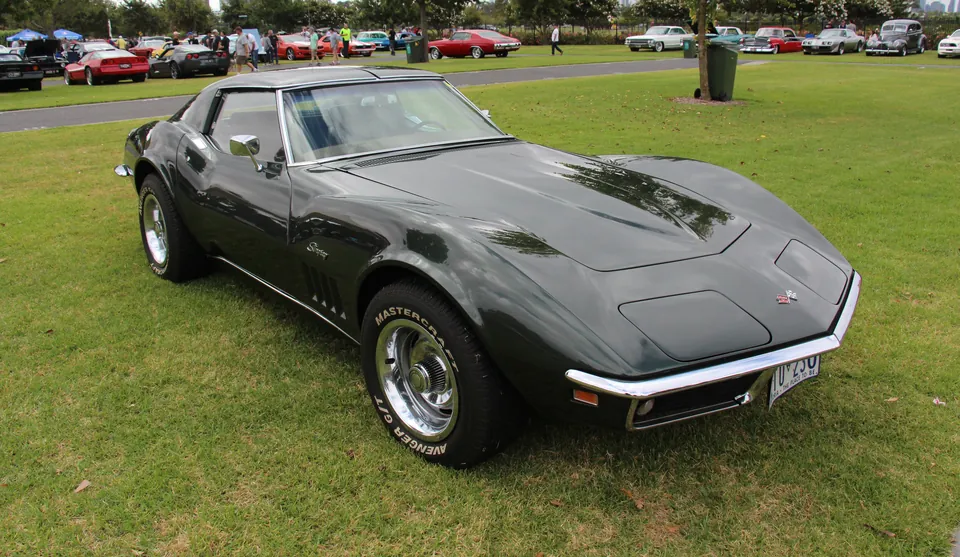
Chevrolet Corvette (C3)
Why 7.0: The C3 ran from the horsepower peak of 1968 straight through the emissions collapse, and by 1975 the base car left the factory with 165 hp. That arc is exactly why nobody speculates on it — more were built than any other Corvette generation, the weak years are cheap, and there is no money in leaving one alone.
Layout
Natural habitat
Ride comfort
Sound
An early big-block car with the low-restriction exhaust barks as hard as any Corvette. But most survivors are the late strangled ones, catalysed and down to 165 hp, so across fifteen model years it averages out as a V8 you can hear rather than one worth seeking.
8-cylinder · naturally aspirated · 6,000 rpm redline · rated 6.4 / 10 for engine sound
Market value
Median asking price, good condition · €5k (1970) → €24k (2026), trending up · illustrative data
Child seats · ISOFIX
Built before ISOFIX existed, so there are no anchor points at all. A child seat here is a seatbelt installation in the only passenger seat there is.
Derived from production years and seating layout, not a per-car source. ISOFIX was standardised as ISO 13216 in 1997, required on new EU model types from 2011 and on all new EU cars from 2014.
The long version
Chevrolet dropped the Mako Shark II concept body onto the C2's chassis for 1968 and then kept selling it for fifteen model years, longer than any other Corvette generation before or since. What happened in between is the story. The 1968 and 1969 cars could be ordered with a 427 rated at 435 hp and the 454 followed for 1970; then unleaded fuel, falling compression, catalytic converters and the switch from gross to net ratings hollowed the range out until the 1975 base car made 165 hp. The bodywork tracked the decline — chrome bumpers gave way to body-colour urethane at the front for 1973 and at the rear for 1974 — while the lift-out T-top roof panels, a Corvette first, stayed throughout. Well over half a million were built, more than any generation since, and that is precisely why this is the Corvette nobody garages. The early big-blocks and the rare L88 and ZR-1 cars have their own market, but a mid-run small-block remains one of the cheapest genuinely interesting V8 cars on the road, and its owners behave accordingly.