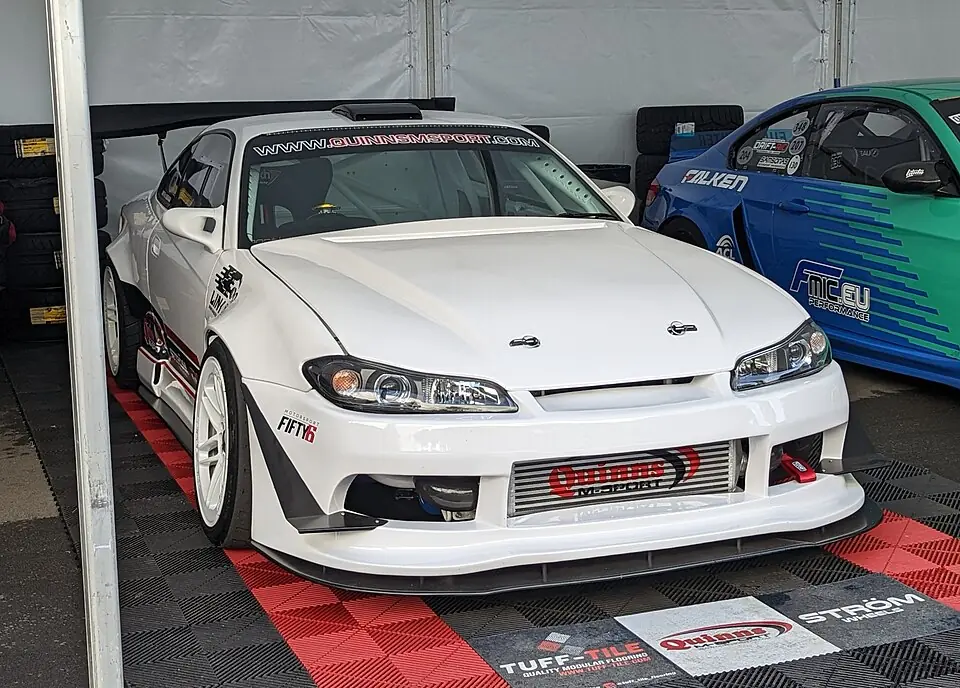
Nissan Silvia (S15)
Why 4.3: The best chassis drifting ever standardized on, now aging out of grassroots budgets. The clean survivors go collector; the rest still live sideways — the AE86 story, twenty years later.
Layout
Natural habitat
Ride comfort
Sound
The SR20DET makes the hard, sharp four-cylinder chatter a whole generation associates with drifting, and it will hold 7,500 all day. But it is a single-turbo two-litre where most of the noise comes from boost hardware, not combustion. Middling.
4-cylinder · turbocharged · 7,500 rpm redline · rated 5.3 / 10 for engine sound
Market value
Median asking price, good condition · €14k (2005) → €51k (2026), trending up · illustrative data
Child seats · ISOFIX
ISOFIX was spreading through these years rather than fitted across the board — whether a given car has rear anchors depends on its year and market.
Children were expected in the back. Front-passenger ISOFIX effectively didn't exist in this era, and airbag deactivation was patchy — treat the front seat as a no unless a specific car proves otherwise.
Derived from production years and seating layout, not a per-car source. ISOFIX was standardised as ISO 13216 in 1997, required on new EU model types from 2011 and on all new EU cars from 2014.
The long version
The 25-year import window turned into a straightforward arbitrage trade for a while — buy clean in Japan or Australia, ship, flip stateside for a multiple, repeat — and the badges here reflect how many S15s never saw a US driveway before changing hands again. The ones that escaped that cycle mostly went where the chassis was always meant to go: grassroots drift events, sideways and consumable. Values have climbed enough now that even the drift cars are getting babied a little, its own kind of ending for a car built to be worn out.