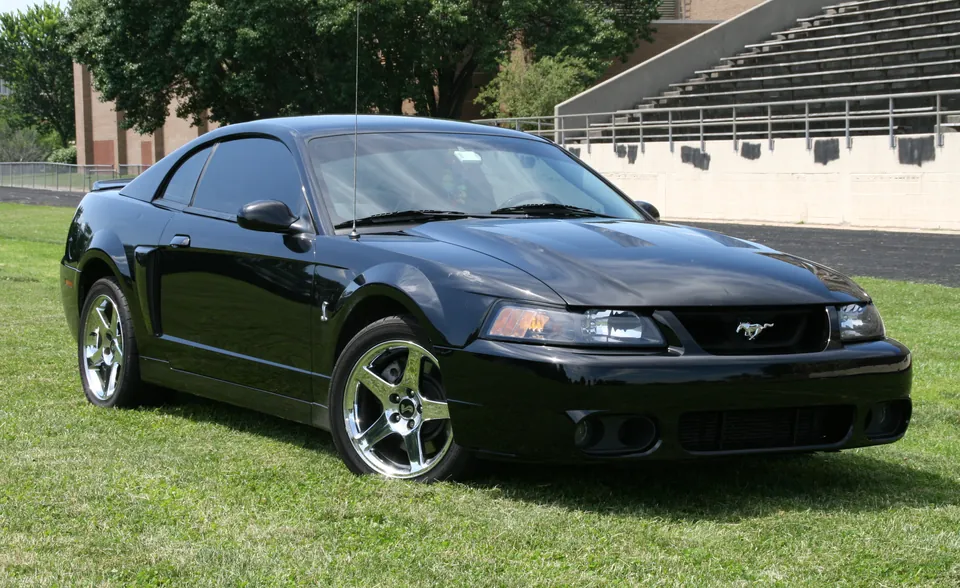
Ford Mustang SVT Cobra "Terminator"
Why 6.8: SVT gave the last New Edge Cobra an iron block, forged internals, an Eaton supercharger and an independent rear end no other Mustang of the period got — then quoted 390 hp, a figure the dyno has been arguing with ever since. It became the default American tuning platform of the decade, and almost every survivor gets driven hard.
Layout
Natural habitat
Ride comfort
Sound
The M112 blower whine is the entire signature, layered over a modular 4.6 that is smoother and less vocal than any pushrod V8. The factory exhaust is muted and 6,500 rpm arrives quickly, so this is supercharger noise more than engine noise.
8-cylinder · supercharged · 6,500 rpm redline · rated 6.9 / 10 for engine sound
Market value
Median asking price, good condition · €32k (2004) → €48k (2026), trending up · illustrative data
Child seats · ISOFIX
ISOFIX was spreading through these years rather than fitted across the board — whether a given car has rear anchors depends on its year and market.
Children were expected in the back. Front-passenger ISOFIX effectively didn't exist in this era, and airbag deactivation was patchy — treat the front seat as a no unless a specific car proves otherwise.
Derived from production years and seating layout, not a per-car source. ISOFIX was standardised as ISO 13216 in 1997, required on new EU model types from 2011 and on all new EU cars from 2014.
The long version
The 2003 SVT Cobra is the last and by some distance the best of the New Edge Mustangs, and it is remembered by a nickname rather than a model code. Ford's Special Vehicle Team built it on an iron block instead of the outgoing aluminium one, filled it with a forged crank, forged rods and forged pistons, bolted an Eaton M112 supercharger on top and quoted 390 hp and 390 lb-ft — numbers treated as conservative from the day it launched, because a standard car will put close to that down at the wheels. Behind it sat a Tremec T-56 six-speed; underneath was an independent rear suspension no other Mustang of the era received and which the following S197 generation abandoned again. Around nineteen thousand were built over two model years. What happened next is unusual for a fast Ford: the bottom end takes far more boost than it shipped with, so the Terminator became the tuning platform of the 2000s and the surviving population is now split between heavily modified cars and a shrinking number of untouched ones. Both get used. Values have roughly doubled off their 2010s floor without ever reaching the point where owners stop driving them.