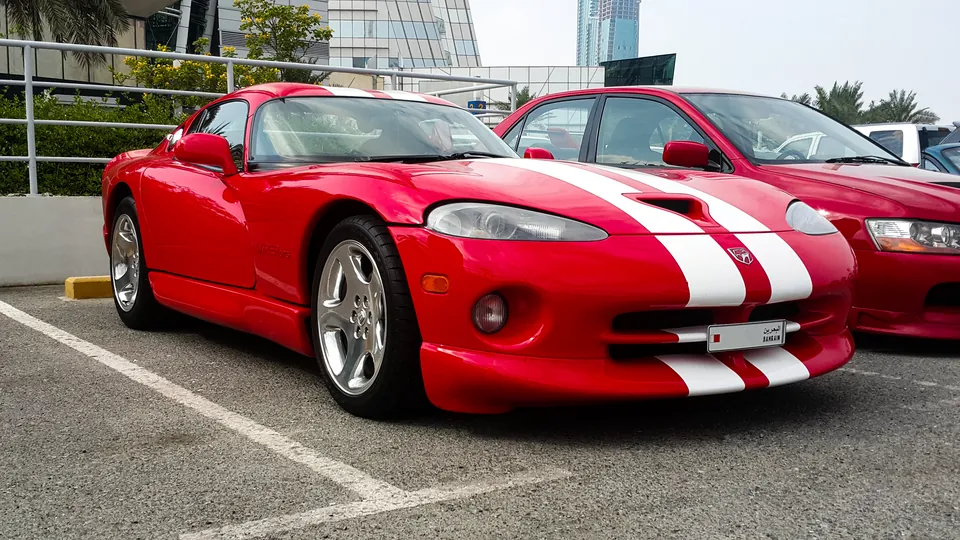
Dodge Viper GTS
Why 6.0: Dodge put a roof on the Viper, found another 50 hp and fitted air conditioning, then still shipped it with no traction control and no anti-lock brakes until 2001. The double-bubble coupe is the shape everybody pictures, and the GTS-R derived from it took its class at Le Mans three years running.
Layout
Natural habitat
Ride comfort
Sound
Eight litres and ten cylinders with side pipes inches from your ear, which is a sound nothing else replicates. It is capped by revving to only 6,000 and by an agricultural edge that never quite becomes music.
10-cylinder · naturally aspirated · 6,000 rpm redline · rated 7.0 / 10 for engine sound
Market value
Median asking price, good condition · €61k (1997) → €72k (2026), trending up · illustrative data
Child seats · ISOFIX
There aren't any — strict two-seater.
The only position there is — and the weak point of this era. Airbag cut-off switches only became routine in the mid-2000s; many of these cars have none from the factory, which rules out a rear-facing seat entirely unless a dealer-fitted deactivation was installed. Forward-facing on the belt, seat slid fully back, is what the period manuals allow.
Derived from production years and seating layout, not a per-car source. ISOFIX was standardised as ISO 13216 in 1997, required on new EU model types from 2011 and on all new EU cars from 2014.
The long version
The GTS is the Viper that made the car more than a stunt. Where the RT/10 roadster was deliberately primitive — no exterior door handles, no proper roof, side pipes hot enough to brand a passenger — the 1996 coupe added a fixed roof with the double bubble that clears a helmet, wind-up windows, air conditioning, and a substantially reworked 8.0-litre V10 making 450 hp and 490 lb-ft from a block lighter than the one it replaced. It kept what its reputation rested on: no traction control in any year, and no anti-lock brakes until the 2001 model year. The racing version justified the rest — Oreca's GTS-R won the GT2 class at Le Mans in 1998, 1999 and 2000 and took the FIA GT championship twice, a record no other American road car of the era comes close to. Prices bottomed around forty thousand dollars in the middle of the last decade, low enough that buyers were people who wanted to drive one rather than store one, and although the market has firmed since, a Gen II GTS remains the cheapest way to own a V10 that is genuinely difficult.