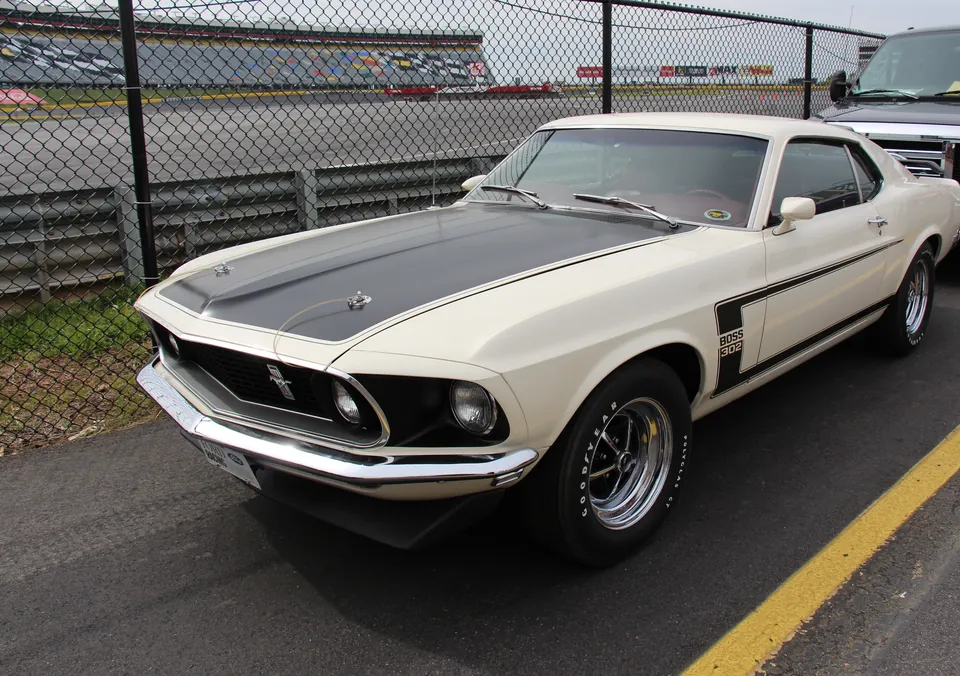
Ford Mustang Boss 302
Why 3.5: SCCA Trans-Am demanded 1,000 road cars in 1969 and 7,000 in 1970; Ford built 1,628 and then 7,013. The 290 hp rating was gross and understated by consensus, Parnelli Jones and George Follmer won Ford the 1970 title in it, and it is now a six-figure car that leaves the garage rarely.
Layout
Natural habitat
Ride comfort
Sound
Solid lifters and canted-valve heads make this the Ford small-block that wants revs, and it barks harder and higher than any big-block of the era. It is still a pushrod V8 stopping at 6,200 rpm, which caps it below the engines built to sing rather than shout.
8-cylinder · naturally aspirated · 6,200 rpm redline · rated 7.9 / 10 for engine sound
Market value
Median asking price, good condition · €4k (1972) → €138k (2026), trending up · illustrative data
Child seats · ISOFIX
Built before ISOFIX existed, so there are no anchor points at all. A child seat here is a seatbelt installation, and the belt geometry of the period was not designed with one in mind.
Derived from production years and seating layout, not a per-car source. ISOFIX was standardised as ISO 13216 in 1997, required on new EU model types from 2011 and on all new EU cars from 2014.
The long version
The Boss 302 exists because Ford wanted to beat the Camaro Z/28 in SCCA Trans-Am racing, and Trans-Am required road cars as proof. Larry Shinoda — poached from General Motors, which is where both the C-stripe and the name came from — did the bodywork. The engine was a 302 short block with the large-port Cleveland heads, a solid-lifter camshaft and a quoted 290 hp that almost nobody believed in period, because the class capped displacement at five litres and every manufacturer was underquoting. A four-speed manual was the only gearbox, and the chassis got quick-ratio steering, stiffer springs and a front spoiler because the race programme needed them homologated. The minimum was 1,000 cars for 1969, so Ford built 1,628; the SCCA raised it to 7,000 for 1970, so Ford built 7,013. On track it worked, with Jones and Follmer taking the 1970 manufacturers' championship. Off track, the Boss 302 spent the following decades becoming a blue-chip muscle car, and clean documented examples now sit well into six figures. That is the entire ownership picture: shown, insured, occasionally exercised, very seldom used.