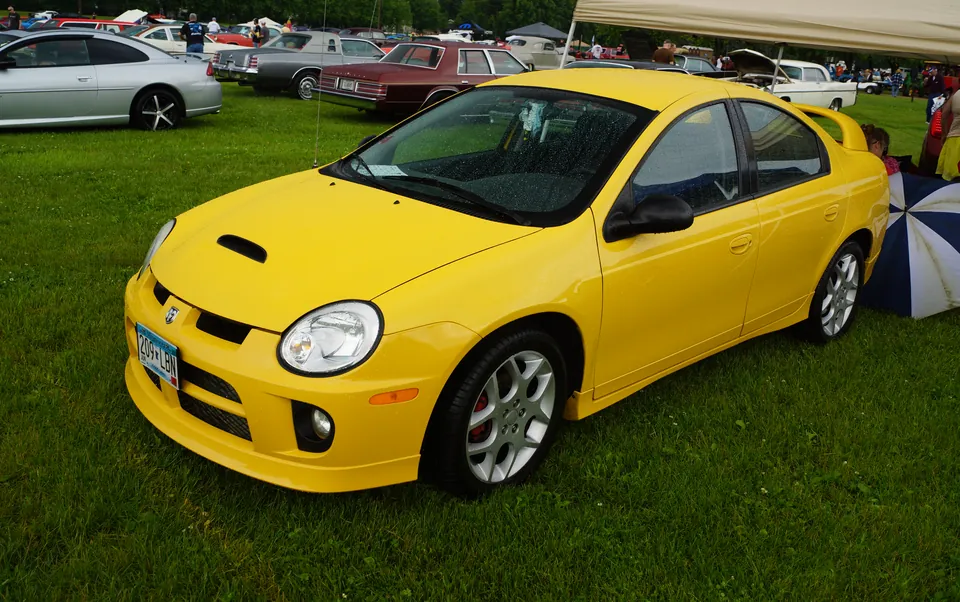
Dodge Neon SRT-4
Why 8.3: Chrysler's new SRT division took the cheapest car it had, turbocharged it to 215 hp and then 230, and undercut everything that could match it in a straight line by about ten thousand dollars. No factory limited-slip differential was ever fitted, in any model year, which is why the torque steer is what everyone remembers.
Layout
Natural habitat
Ride comfort
Sound
The 2.4 turbo makes an unmistakable amount of noise: boost, blow-off and a tailpipe wide enough to see through. Underneath it is a coarse, droning Chrysler four with no character of its own, so volume is standing in for a decent engine note.
4-cylinder · turbocharged · 6,200 rpm redline · rated 4.8 / 10 for engine sound
Market value
Median asking price, good condition · €18k (2004) → €17k (2026), trending down · illustrative data
Child seats · ISOFIX
ISOFIX was spreading through these years rather than fitted across the board — whether a given car has rear anchors depends on its year and market.
Children were expected in the back. Front-passenger ISOFIX effectively didn't exist in this era, and airbag deactivation was patchy — treat the front seat as a no unless a specific car proves otherwise.
Derived from production years and seating layout, not a per-car source. ISOFIX was standardised as ISO 13216 in 1997, required on new EU model types from 2011 and on all new EU cars from 2014.
The long version
The SRT-4 was the first car the newly formed Street and Racing Technology group put its badge on, and the brief was close to crude: take a Neon, fit a turbocharged 2.4-litre four, sell it for under twenty thousand dollars. It made 215 hp in 2003 and 230 hp for 2004 and 2005, ran the quarter mile in the low fourteens as delivered and into the thirteens with almost nothing done, and came with a five-speed manual, an enormous rear wing and a bonnet scoop that removed any doubt about what it was. What it never came with was a limited-slip differential — the Quaife unit was a dealer accessory — so the defining sensation of driving one hard is the steering wheel trying to leave your hands. Roughly 25,000 were built. Because they were cheap and trivially easy to boost, a large proportion were modified, thrashed and eventually scrapped, and that is exactly why the remainder are still on the road rather than in collections: the market never rewarded preservation, so nobody preserved them. Prices have begun to move off a very low floor, and the cars are still used the way they were bought.