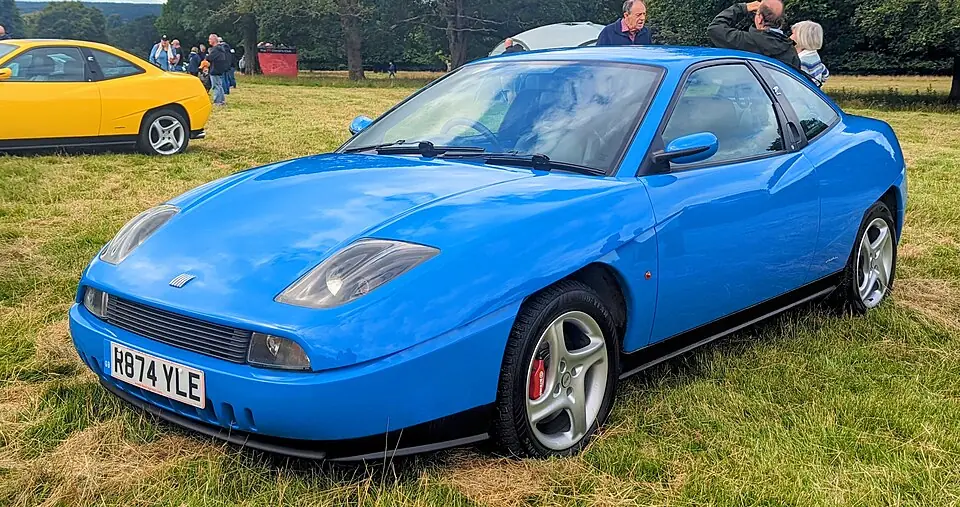
Fiat Coupé 20V Turbo
Why 6.3: Fiat's most powerful production engine of its era was a turbocharged five-cylinder from the same family as the Lancia Delta Integrale, wrapped in a Pininfarina-designed coupe body sold only in Europe. Survivors are cheap, mechanically simple by modern turbo standards, and driven by owners who bought in specifically because nobody else wanted one.
Layout
Natural habitat
Ride comfort
Sound
The five-cylinder gives it the off-beat half-warble no four can produce, and the 20V pulls cleanly to 7,000 rpm. But the turbo muffles the top end and much of the drama is boost and blow-off rather than the engine, which keeps it in character rather than melody territory.
5-cylinder · turbocharged · 7,000 rpm redline · rated 6.2 / 10 for engine sound
Market value
Median asking price, good condition · €29k (1996) → €21k (2026), trending down · illustrative data
Child seats · ISOFIX
ISOFIX was spreading through these years rather than fitted across the board — whether a given car has rear anchors depends on its year and market.
Children were expected in the back. Front-passenger ISOFIX effectively didn't exist in this era, and airbag deactivation was patchy — treat the front seat as a no unless a specific car proves otherwise.
Derived from production years and seating layout, not a per-car source. ISOFIX was standardised as ISO 13216 in 1997, required on new EU model types from 2011 and on all new EU cars from 2014.
The long version
Fiat commissioned the shape from Pininfarina's studio under Chris Bangle and then, uncharacteristically for the era, backed it with a genuinely serious engine — a 20-valve turbocharged five-cylinder making 220 hp, more than any other production Fiat had offered before it. It never came anywhere near a US showroom, so the entire ownership population outside Europe is a handful of grey-market imports and forum-famous outliers. Rust and Fiat's era-appropriate reliability reputation kept prices on the floor for two decades, which produced exactly the ownership pattern that floor prices always produce: buyers who wanted this specific five-cylinder turbo coupe badly enough to accept the risk, and who drive the survivors rather than trailer them. The classic-car market has only recently started noticing, so today's buyers are still getting a genuinely distinctive Pininfarina shape for money that wouldn't touch a comparable Alfa.