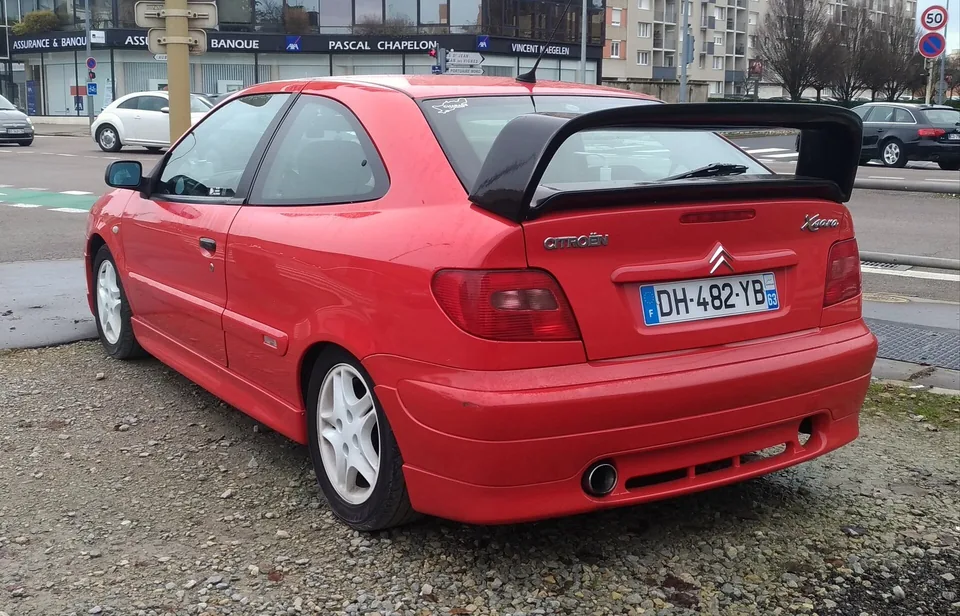
Citroën Xsara VTS
Why 8.5: The Saxo VTS's bigger brother: the same naturally aspirated 16-valve recipe stretched to two litres and 167 hp, in a five-seat hatchback that still weighed only 1,150 kg. It revs to seven, lifts an inside rear wheel on demand, and was sold as an ordinary family Citroën.
Layout
Natural habitat
Ride comfort
Sound
The 2.0 16-valve pulls cleanly to 7,000 rpm and hardens up past 5,000, which is more than most PSA fours manage. But there is no cam-switching moment and no exhaust theatre — just a competent four getting louder. Enjoyable at the time, forgettable afterwards.
4-cylinder · naturally aspirated · 7,000 rpm redline · rated 5.6 / 10 for engine sound
Market value
Median asking price, good condition · €18k (2001) → €6k (2026), trending down · illustrative data
Child seats · ISOFIX
ISOFIX was spreading through these years rather than fitted across the board — whether a given car has rear anchors depends on its year and market.
Children were expected in the back. Front-passenger ISOFIX effectively didn't exist in this era, and airbag deactivation was patchy — treat the front seat as a no unless a specific car proves otherwise.
Derived from production years and seating layout, not a per-car source. ISOFIX was standardised as ISO 13216 in 1997, required on new EU model types from 2011 and on all new EU cars from 2014.
The long version
The Xsara is the car Citroën built its rally reputation on and then almost immediately stopped talking about. The Xsara WRC took the manufacturers' championship in 2003, 2004 and 2005 and carried Sébastien Loeb to his first three drivers' titles, and the showroom car that shared its name was a mid-size hatchback aimed at families, offered in VTS form with the PSA 2.0-litre 16-valve and no turbocharger anywhere. What happened next is the single most common shape on this index and the reason the score lands where it does: it was cheap, it was quick, it was reliable in the way a naturally aspirated PSA four is reliable, and so it was used until it was used up. Insurance groupings in Britain put VTSs in the hands of drivers in their early twenties for a decade, which finished off most of them; the rest went to France's provincial back roads and stayed there. Survivors are now genuinely scarce, and prices have started their first ever upward move from something very close to scrap value — but they are moving in the hands of people who want to drive one, because a Xsara has no badge value whatsoever and never will. High miles, no flipping, and an ownership culture that never once treated the car as an object.