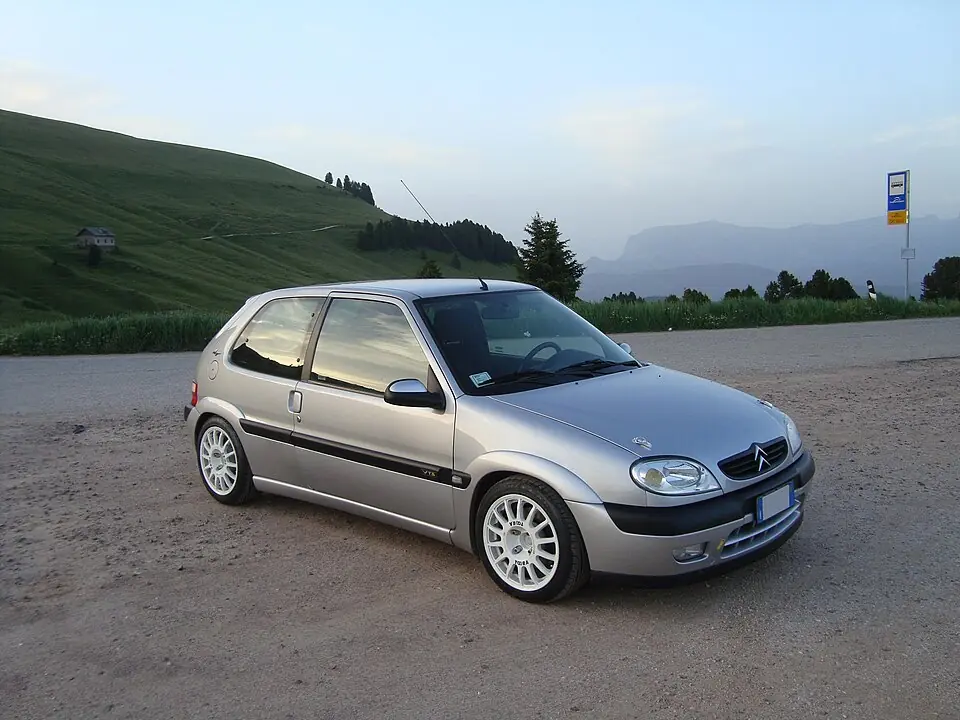
Citroën Saxo VTS
Why 7.3: 118 horsepower, 950 kilograms, no electronic nannies to speak of — a genuinely great chassis that cost almost nothing new and costs almost nothing now. Saxo VTS owners buy them to thrash, not to store, and the ones still alive have mostly been driven hard by people who loved doing it.
Layout
Natural habitat
Ride comfort
Sound
The TU5J4 buzzes hard and the induction turns genuinely urgent past 6,000 rpm on the way to 7,200, which is most of why people thrash them. But it is a 1.6 with a thin, tinny exhaust and no low-end presence — honest small-car noise, and nothing anyone would record.
4-cylinder · naturally aspirated · 7,200 rpm redline · rated 5.2 / 10 for engine sound
Market value
Median asking price, good condition · €15k (1998) → €12k (2026), trending down · illustrative data
Child seats · ISOFIX
ISOFIX was spreading through these years rather than fitted across the board — whether a given car has rear anchors depends on its year and market.
Children were expected in the back. Front-passenger ISOFIX effectively didn't exist in this era, and airbag deactivation was patchy — treat the front seat as a no unless a specific car proves otherwise.
Derived from production years and seating layout, not a per-car source. ISOFIX was standardised as ISO 13216 in 1997, required on new EU model types from 2011 and on all new EU cars from 2014.
The long version
The Saxo VTS never came within an ocean of a US showroom, which makes it Forbidden Fruit by default, but the real ownership story is European: this was the budget hot hatch a generation of drivers cut their teeth on, bought cheap, modified on a shoestring, and drove into the ground on B-roads and at track days rather than preserved behind glass. Attrition has been brutal — most examples were crashed, rusted, or thrashed to mechanical death by owners in their twenties with more enthusiasm than money — which is exactly why clean survivors command real money today. The ones that remain are disproportionately owned by people who sought this specific car out, know the chassis's reputation, and intend to keep driving it the way it was always driven. There's no flip economy here worth mentioning; nobody buys a Saxo VTS as an investment, they buy it because it's still one of the best-handling cheap cars ever built.