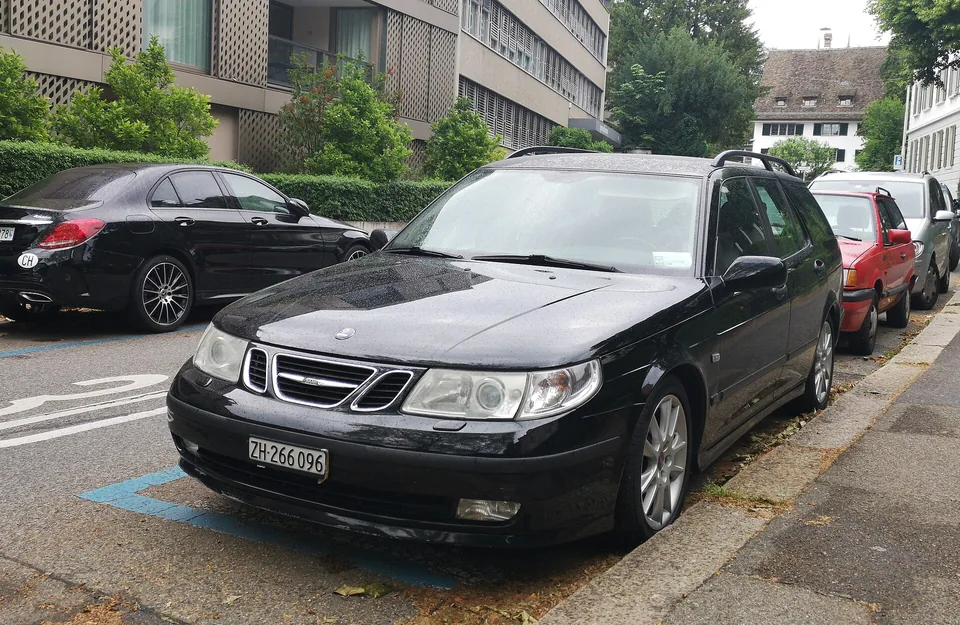
Saab 9-5 Aero
Why 8.5: Saab's last real performance wagon: 250 hp from a 2.3-litre four that started life in the 1980s, all of it through the front wheels, in an estate designed around Scandinavian winters and long distances. Nothing about it was fashionable, which is exactly why the people who bought them kept them.
Layout
Natural habitat
Ride comfort
Sound
The B235R makes 250 hp without ever raising its voice, which was precisely the brief for a fast estate that never announces itself. But refinement is the whole point, so there is only a distant boosted hum. One of the quietest genuinely quick cars here.
4-cylinder · turbocharged · 6,200 rpm redline · rated 4.0 / 10 for engine sound
Market value
Median asking price, good condition · €37k (2003) → €8k (2026), trending down · illustrative data
Child seats · ISOFIX
ISOFIX was spreading through these years rather than fitted across the board — whether a given car has rear anchors depends on its year and market.
Children were expected in the back. Front-passenger ISOFIX effectively didn't exist in this era, and airbag deactivation was patchy — treat the front seat as a no unless a specific car proves otherwise.
Derived from production years and seating layout, not a per-car source. ISOFIX was standardised as ISO 13216 in 1997, required on new EU model types from 2011 and on all new EU cars from 2014.
The long version
The first-generation 9-5 was already an old design by the time the Aero reached 250 hp in 2002, and Saab knew it — the company had been under General Motors since 1990 and would be sold to Spyker in 2010 and liquidated in 2012, and the 9-5 ran for thirteen years because there was never money for a replacement. The consequence for owners was a car that depreciated harder than almost anything else with that specification: an Aero SportCombi that cost around $40,000 new was a $6,000 car by 2012 and is still not much more now, which put a 250 hp turbocharged five-seat estate within reach of people who had no interest in a performance car at all and simply wanted something big, safe and cheap. They drove them, because that is what you do with a car worth less than the annual insurance on a fast one. Two hundred thousand miles is unremarkable and the forum culture around keeping them running — direct-ignition cassettes, sludge-prone early engines, the Hirsch tuning parts — is one of the more determined in Europe, which it has had to be since the parts supply became a community problem rather than a dealer one. There is essentially no speculative market for a first-generation 9-5 and there is unlikely ever to be one. That is what a high score on this index actually describes.