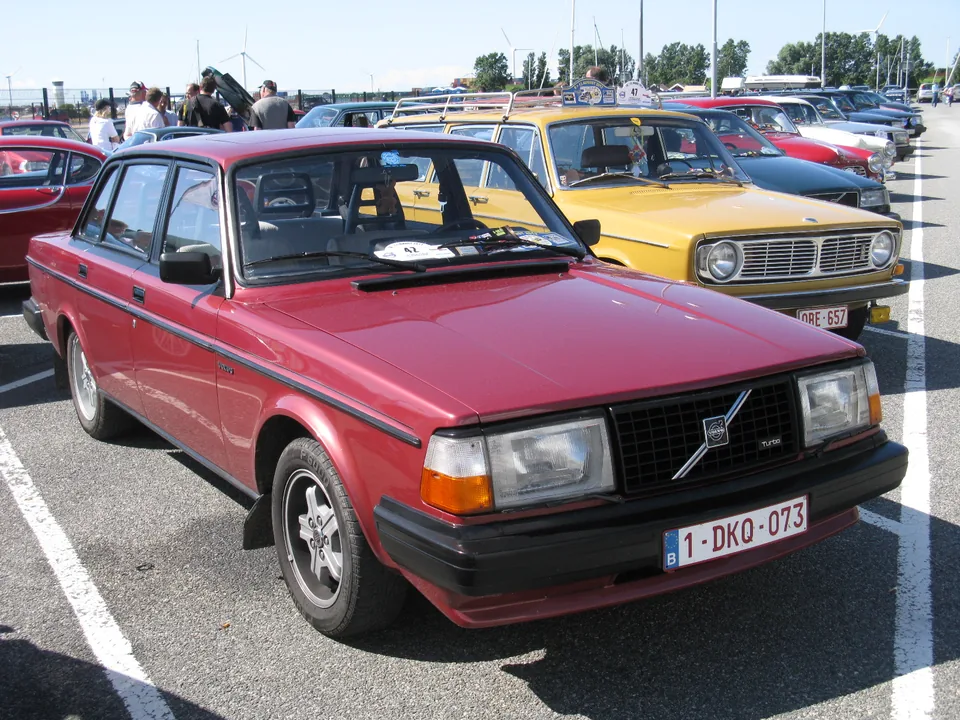
Volvo 240 Turbo
Why 8.3: Volvo bolted a Garrett turbo to its 2.1-litre four in 1980 and got 155 hp and 240 Nm out of a car shaped like a filing cabinet. The Group A version of the same thing weighed 1,065 kg, made around 350 bhp and won the 1985 European Touring Car Championship outright, beating BMW, Jaguar and Rover.
Layout
Natural habitat
Ride comfort
Sound
The low-pressure Garrett on the iron 2.1 gives a genuine induction whoosh over a gruff, agricultural idle. But it is silenced for a family saloon, revs only to 5,800 and does none of what it did in touring-car trim. Character by accident rather than by design.
4-cylinder · turbocharged · 5,800 rpm redline · rated 4.4 / 10 for engine sound
Market value
Median asking price, good condition · €16k (1984) → €20k (2026), trending up · illustrative data
Child seats · ISOFIX
Built before ISOFIX existed, so there are no anchor points at all. A child seat here is a seatbelt installation, and the belt geometry of the period was not designed with one in mind.
Derived from production years and seating layout, not a per-car source. ISOFIX was standardised as ISO 13216 in 1997, required on new EU model types from 2011 and on all new EU cars from 2014.
The long version
Volvo built 2,862,573 200-series cars between 1974 and 1993, and the Turbo is the one that turned the shape into a joke everybody was in on. The “flying brick” nickname came from the racing programme, and the racing programme existed because Group A required a road car, which is why an ordinary Swedish family saloon spent the mid-eighties embarrassing works BMWs. On the road it was never fast in the way the results suggest — 155 hp, considerable lag, a live rear axle and an overdrive switch on the gearlever — but it was rear-wheel drive, endlessly rebuildable and built to a standard that has kept an unreasonable number of them alive. That is the whole ownership story. A 240 is the archetypal keep-forever car: six-figure mileages are the norm rather than the exception, the parts supply is still good after forty years, and the cars pass between owners who intend to use them rather than store them. The Turbo has become a mild collectable in the last decade, which is the one thing pulling the flip factor down from where the ordinary 240 would sit — clean, unmodified, original-paint Turbos now trade for multiples of what they cost in 2005. Most of them are still being driven while that happens, which is the point.