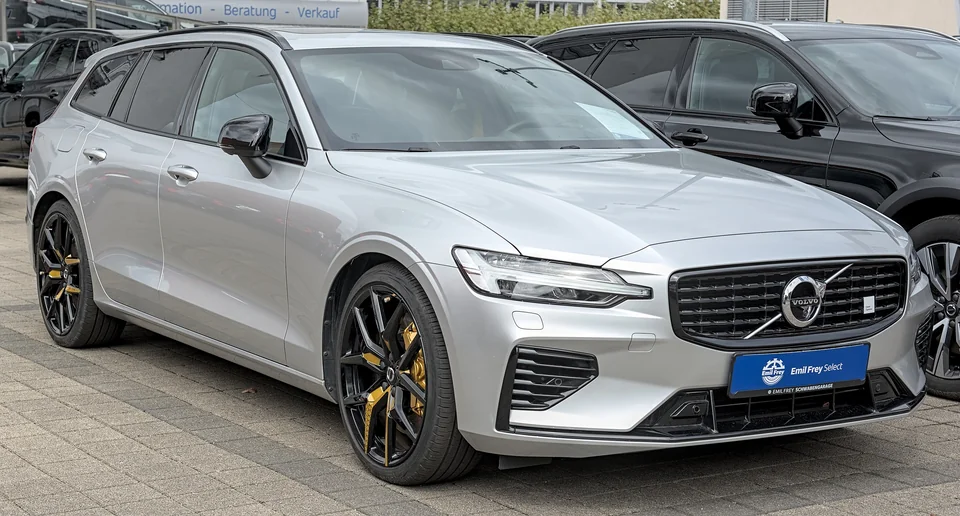
Volvo V60 Polestar Engineered
Why 8.0: A supercharged and turbocharged four driving the front axle, an electric motor driving the rear, 415 hp in total, six-piston Brembos behind gold calipers, and manually adjustable Öhlins DFV dampers with a screw adjuster you reach with a tool. It is the least ostentatious way to buy a genuinely fast estate.
Layout
Natural habitat
Ride comfort
Sound
The T8 has a supercharger whining below 3,000 rpm before the turbo takes over, so there are at least two things making noise. But it is a 2.0 four under Volvo's insulation with a 6,000 rpm limit, and the hybrid layer mutes even that. Quick and near-inaudible.
4-cylinder · turbocharged · 6,000 rpm redline · rated 3.9 / 10 for engine sound
Market value
Median asking price, good condition · €63k (2020) → €31k (2026), trending down · illustrative data
Child seats · ISOFIX
Two ISOFIX positions on the outer rear seats, the outer pair being the ones the standard covers.
The rear anchors are the supported route — the manual points child seats there, and front-passenger ISOFIX is the exception rather than the rule. A belt-mounted seat up front needs the airbag off, and cars with a rear row don't always fit a deactivation switch, precisely because the rear seats exist.
Derived from production years and seating layout, not a per-car source. ISOFIX was standardised as ISO 13216 in 1997, required on new EU model types from 2011 and on all new EU cars from 2014.
The long version
Polestar was Volvo's racing partner and then its in-house tuning arm, and the Polestar Engineered badge is what survived when the name was spun off into a standalone electric brand in 2017. What it bought you on a V60 was not a bodykit: it was Öhlins dual-flow-valve dampers with twenty-two clicks of manual adjustment, larger Brembo brakes, a strut brace, and a retuned T8 powertrain making 415 hp. Volvo built them in tiny numbers — a few hundred a year worldwide — and sold them almost exclusively by subscription or direct order, which meant they never had the showroom presence to attract the kind of buyer who is shopping for a badge. The people who ended up with one wanted a fast wagon and were prepared to explain it at dinner parties. That produces the ownership pattern the index rewards: high annual mileage, because it is a comfortable long-distance estate; essentially zero speculative interest, because the market has never worked out what a modern Polestar-badged Volvo is worth; and a plug-in hybrid drivetrain whose warranty exposure keeps prices sensible. The wagon body means most of them are doing family duty rather than sitting. Nobody is storing one for 2040.