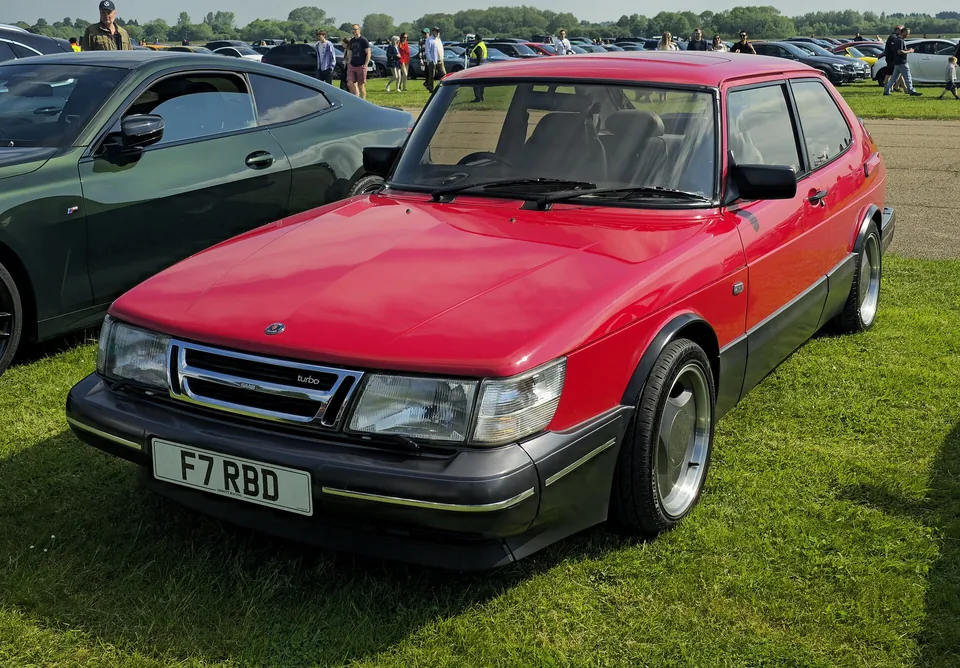
Saab 900 Turbo (classic)
Why 8.0: Saab put a turbocharger on a two-litre four in 1978 and spent fifteen years refining it, reaching 175 hp once the 16-valve head arrived. The engine sits back-to-front with the gearbox underneath it in the sump, the windscreen curves round the driver, and the ignition barrel is on the floor between the seats.
Layout
Natural habitat
Ride comfort
Sound
Off boost the slant-four is gruff and hollow; on boost there is a real wastegate wheeze and the APC system chattering behind it. But it is a two-valve 2.0 stopping at 6,000 rpm, and nearly all the character is turbo plumbing rather than the engine itself.
4-cylinder · turbocharged · 6,000 rpm redline · rated 4.6 / 10 for engine sound
Market value
Median asking price, good condition · €23k (1988) → €22k (2026), trending down · illustrative data
Child seats · ISOFIX
Built before ISOFIX existed, so there are no anchor points at all. A child seat here is a seatbelt installation, and the belt geometry of the period was not designed with one in mind.
Derived from production years and seating layout, not a per-car source. ISOFIX was standardised as ISO 13216 in 1997, required on new EU model types from 2011 and on all new EU cars from 2014.
The long version
Saab built 908,817 classic 900s between 1978 and 1993 and almost none of them were bought as sports cars, which is the fact that governs everything below. The 900 Turbo sold on a cabin that treated the driver as a pilot and on genuine long-distance ability — heated seats, which Saab offered before anyone else, and a heater that worked in a Swedish February, seats good enough to justify the mythology — and it was used accordingly: as a year-round car in Scandinavia, New England and Britain, at annual distances no ordinary quick coupé ever sees. General Motors took control in 1989 and the NG900 that replaced this car in 1994 shared its floorpan with the Vauxhall Cavalier, which is exactly why the pre-GM car is the one with a following and why naming the generation matters. Values bottomed out around 2000, when a rusty Turbo was worth less than a set of tyres, and have climbed steadily since without ever going speculative: a good one now costs roughly what it cost new in nominal terms, and the buyers are Saab people rather than dealers. Saab went into bankruptcy in 2011 and stopped for good in 2012, so parts supply became an owners' project — and a fleet kept alive by its own community is, by definition, a fleet still being driven.