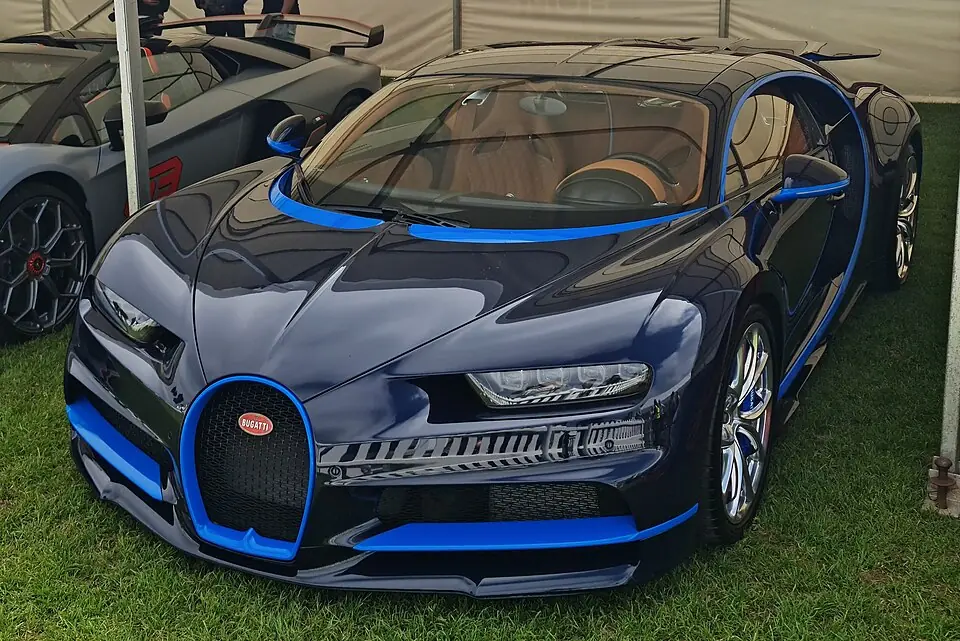
Bugatti Chiron
Why 2.0: Bugatti finally gave the Chiron a steering rack that talks back — a real gain over the Veyron's detachment — but 2,070 kg, permanent AWD and a DSG built for repeatability keep every other lens well short of an analog supercar. The lens that moved is chassis feel; the one that didn't is mass.
Layout
Natural habitat
Ride comfort
Sound
The same W16 with larger turbos, more insulation and a quieter cabin, so the deep roar sits further away than the Veyron's. It is capped by design — Bugatti deliberately tuned this one for calm. The less audible of the two, and rated accordingly.
16-cylinder · turbocharged · 6,700 rpm redline · rated 5.7 / 10 for engine sound
Market value
Median asking price, good condition · €2.8M (2016) → €3.7M (2026), trending up · illustrative data
Child seats · ISOFIX
There aren't any — strict two-seater.
The only position there is, so makers of this era equip it: expect a passenger-airbag cut-off (key switch or occupant sensing) as standard, because there is no rear row to point children to. Whether the seat itself carries ISOFIX anchors is maker-specific — Porsche bundles them with its child-seat preparation, Ferrari sold them as an option, others are belt-mount only with the airbag off.
Derived from production years and seating layout, not a per-car source. ISOFIX was standardised as ISO 13216 in 1997, required on new EU model types from 2011 and on all new EU cars from 2014.
The long version
Chiron buyers inherited the Veyron's collector-first ownership pattern almost unchanged, even as journalists praised the newer car for finally feeling like something a driver does rather than something that happens to a passenger. Production wrapped in 2024 at a fixed, oversubscribed run, and allocation slots have traded hands for premiums before the cars themselves were finished — the surest sign that acquisition is the point for a meaningful share of buyers. What driving happens clusters around factory events and closed circuits, not commutes.