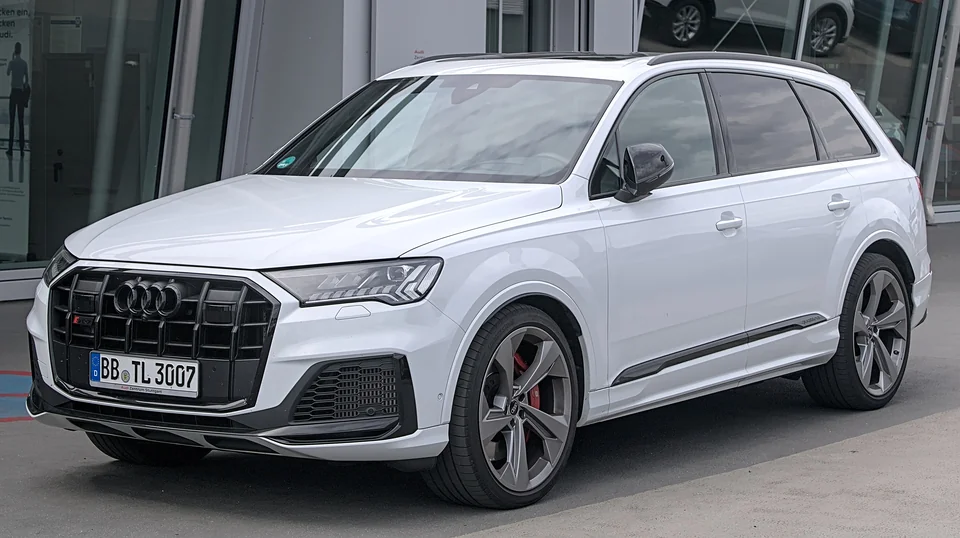
Audi SQ7
Why 7.5: A three-row family SUV with the RS Q8's platform, a 500 hp twin-turbo V8, and a 48-volt electrically actuated anti-roll system that flattens 2.3 tonnes through a corner it has no business taking quickly. It is the fastest school run available with a boot big enough for the school run.
Layout
Natural habitat
Ride comfort
Sound
The electric compressor kills diesel lag entirely and the 4.0 TDI does thump hard under load. But the eight-cylinder note you actually hear is largely a sound actuator in the exhaust, adjustable through drive select — augmentation, however well executed.
8-cylinder · turbocharged · 6,800 rpm redline · rated 4.2 / 10 for engine sound
Market value
Median asking price, good condition · €79k (2020) → €40k (2026), trending down · illustrative data
Child seats · ISOFIX
Two ISOFIX positions on the outer rear seats, the outer pair being the ones the standard covers.
The rear anchors are the supported route — the manual points child seats there, and front-passenger ISOFIX is the exception rather than the rule. A belt-mounted seat up front needs the airbag off, and cars with a rear row don't always fit a deactivation switch, precisely because the rear seats exist.
Derived from production years and seating layout, not a per-car source. ISOFIX was standardised as ISO 13216 in 1997, required on new EU model types from 2011 and on all new EU cars from 2014.
The long version
The SQ7 exists because Audi wanted the Q7's practicality without conceding the performance argument to the Cayenne, and it went about it in a characteristically over-engineered way. The European launch car used a 4.0-litre V8 diesel with an electric compressor spooling the turbos below 1,500 rpm; the American car, and the later European ones, use the 4.0 TFSI petrol V8 shared with the RS Q8 and the Urus, at 500 hp. Either way the trick component is the same: an electromechanical active roll stabilisation system running off a 48-volt subsystem, which lets a tall three-row SUV corner flat without punishing the ride on a motorway. What that produces is a car bought almost entirely on utility. There is no SQ7 collector market and there never will be — the badge sits below the RS Q8 in Audi's own hierarchy and outside Audi's showrooms nobody can tell an SQ7 from a Q7 at a glance, which is precisely why the people who buy them buy them. They cover serious annual mileage, they carry seven people, they tow, and they depreciate hard enough that the second owner is getting an enormous amount of engineering for the money. Nobody has ever stored one.