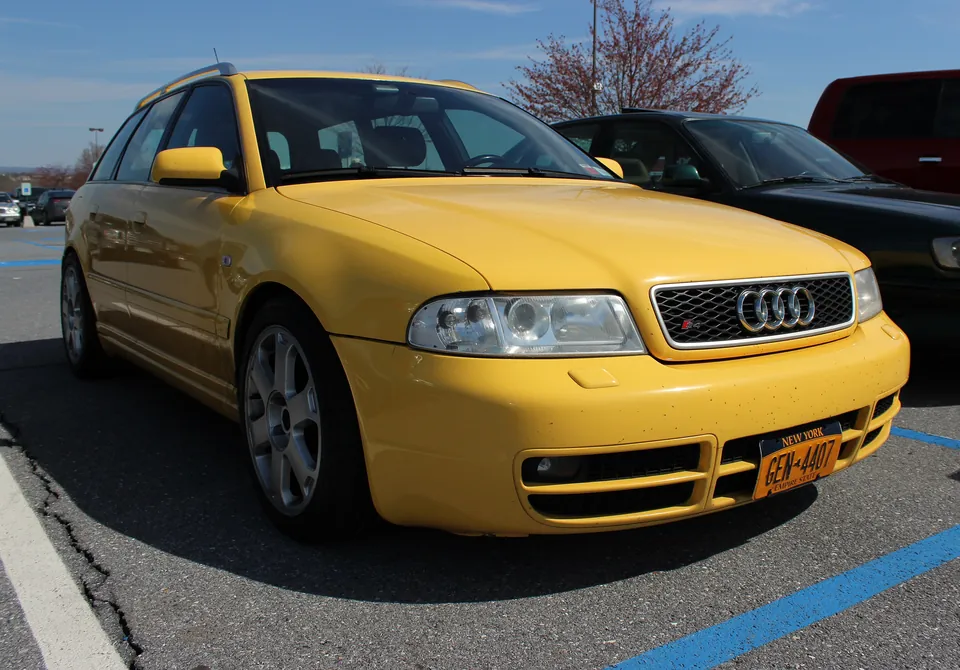
Audi S4 Avant (B5)
Why 6.8: 265 PS and 400 Nm from a 2.7-litre twin-turbo V6, in an estate that looked almost identical to a diesel A4. The engine responded so well to boost and software that the aftermarket spent twenty years finding another 150 hp in it, which is also why so few are standard.
Layout
Natural habitat
Ride comfort
Sound
The same 2.7 biturbo V6, the same spool and lift-off flutter, but with the softer exhaust and quieter tune the S4 shipped with. Very little engine note survives underneath, making it one of the more anonymous sixes here whatever tuners later did with it.
6-cylinder · turbocharged · 7,000 rpm redline · rated 5.0 / 10 for engine sound
Market value
Median asking price, good condition · €36k (2001) → €18k (2026), trending down · illustrative data
Child seats · ISOFIX
ISOFIX was spreading through these years rather than fitted across the board — whether a given car has rear anchors depends on its year and market.
Children were expected in the back. Front-passenger ISOFIX effectively didn't exist in this era, and airbag deactivation was patchy — treat the front seat as a no unless a specific car proves otherwise.
Derived from production years and seating layout, not a per-car source. ISOFIX was standardised as ISO 13216 in 1997, required on new EU model types from 2011 and on all new EU cars from 2014.
The long version
The B5 S4 is the quiet one in this group and the most consequential. Audi put a 2.7-litre twin-turbo V6 — one small turbocharger per bank, 265 PS, 400 Nm from 1,850 rpm — into an A4 with a six-speed manual and quattro, and sold it as a saloon and an Avant with almost no visual announcement beyond aluminium mirrors and a badge. The engine turned out to be enormously tolerant of more boost, and a generation of tuners built businesses on it: chip, then turbos, then a 3.0 stroker, with 400 hp available on standard internals long before that was normal. That success is also why finding a standard one is now hard, and why the reliability reputation is mixed — a lot of what fails on these cars failed because somebody asked more of it. North America got both bodies, which makes the Avant the sensible way in. Values bottomed under $10,000 in the mid-2010s and have recovered slowly; a clean unmolested Avant is now a genuinely sought-after thing.