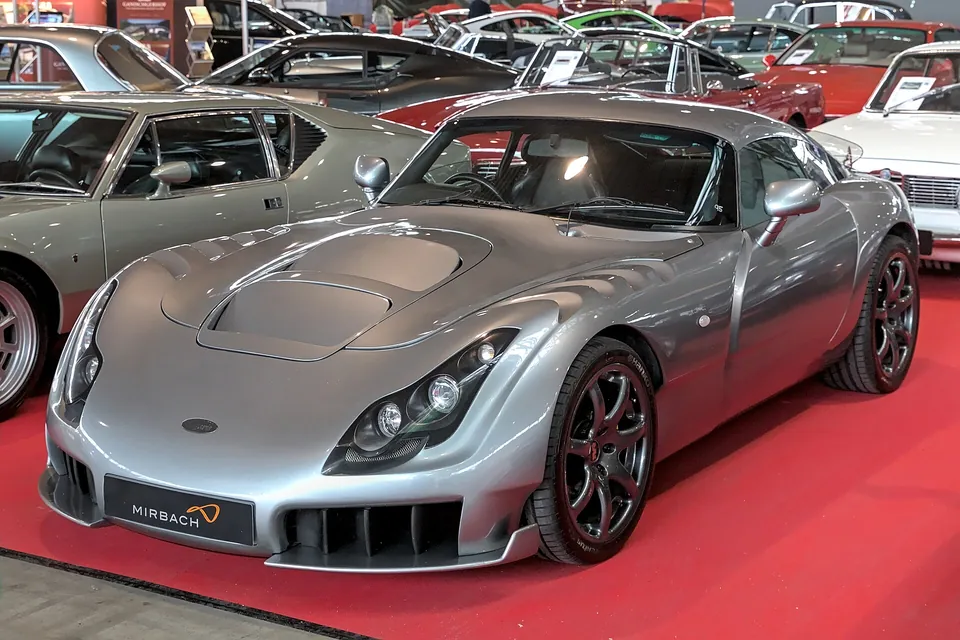
TVR Sagaris
Why 5.0: TVR's last great car: a 4.0-litre Speed Six making 406 bhp at 7,000 rpm in a 1,078 kg body, with no anti-lock brakes and no airbags because Peter Wheeler held that safety equipment made drivers careless. Only 213 were built before TVR collapsed, and values have climbed hard enough that the surviving cars are drifting out of regular use.
Layout
Natural habitat
Ride comfort
Sound
TVR's own Speed Six to 7,500 rpm through side pipes that exit ahead of the rear wheels with almost no silencing — very little sold for the road is this unfiltered. But it is hard and metallic rather than melodic, which holds it below the exotics.
6-cylinder · naturally aspirated · 7,500 rpm redline · rated 8.3 / 10 for engine sound
Market value
Median asking price, good condition · €83k (2005) → €106k (2026), trending up · illustrative data
Child seats · ISOFIX
There aren't any — strict two-seater.
The only position there is — and the weak point of this era. Airbag cut-off switches only became routine in the mid-2000s; many of these cars have none from the factory, which rules out a rear-facing seat entirely unless a dealer-fitted deactivation was installed. Forward-facing on the belt, seat slid fully back, is what the period manuals allow.
Derived from production years and seating layout, not a per-car source. ISOFIX was standardised as ISO 13216 in 1997, required on new EU model types from 2011 and on all new EU cars from 2014.
The long version
The Sagaris appeared as a concept at the MPH03 show in 2003, reached production in 2005, and was finished by the time TVR's collapse played out the following year — 213 cars in total. It is named after a Scythian battle-axe, which is roughly the level of subtlety applied to Graham Browne's bodywork: vented, slotted and gilled everywhere, with a rear wing and side-exit exhausts. The 4.0-litre Speed Six straight-six makes 406 bhp at 7,000 rpm and 349 lb·ft, mounted behind the front axle line in a car weighing 1,078 kg, with no anti-lock brakes, no traction control and no airbags — an EU guideline TVR simply declined to follow, on Wheeler's stated view that safety systems encourage drivers to take liberties. Chief engineer Daniel Boardman spent much of the programme fixing the water ingress, trim and handling complaints that had dogged earlier TVRs, and the Sagaris is generally reckoned the best-sorted car the company ever built. That reputation across only 213 examples has pushed values steadily upward, and the trajectory is exactly why this scores where it does: a car that was a usable if intimidating weapon at £50,000 becomes a more carefully kept one at several times that. Grex Automotive acquired the tooling after the bankruptcy and has offered the Sagaris as a kit since 2018, which is its own comment on how badly people still want one.