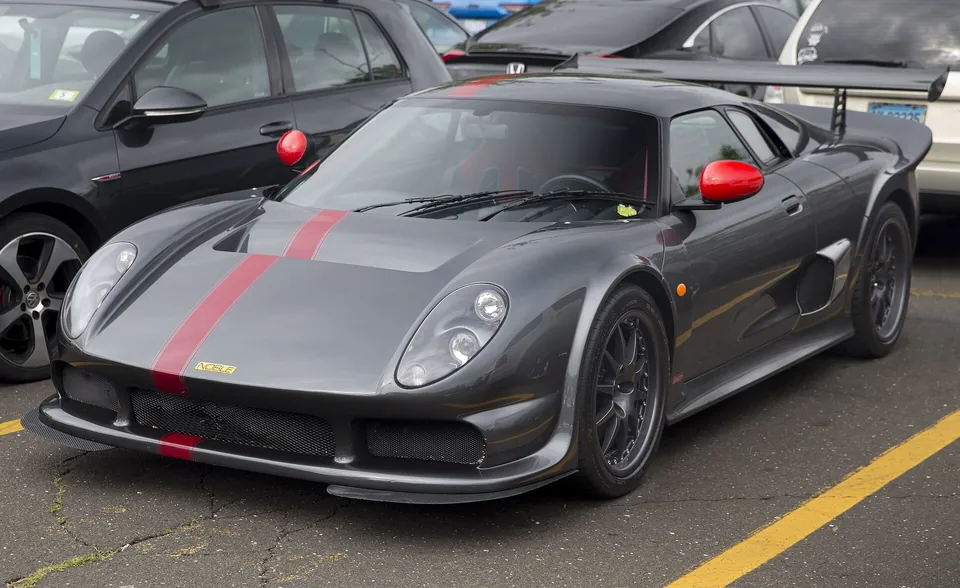
Noble M400
Why 6.1: The name is the spec sheet: 425 hp against 1,060 kg works out at just over 400 hp per tonne, from a twin-turbocharged 3.0-litre Ford Duratec V6 mounted transversely behind the seats. No ABS, no traction control, no stability system and no airbags — the safety equipment is a roll cage and a harness. Owners track them hard and rarely sell.
Layout
Natural habitat
Ride comfort
Sound
More boost and a freer exhaust than the M12, so the spool and blow-off are sharper and some hard-edged V6 rasp finally comes through. But it is still a turbocharged Ford V6, and the mechanical drama outshines the engine note itself.
6-cylinder · turbocharged · 7,000 rpm redline · rated 6.7 / 10 for engine sound
Market value
Median asking price, good condition · €87k (2005) → €110k (2026), trending up · illustrative data
Child seats · ISOFIX
There aren't any — strict two-seater.
The only position there is — and the weak point of this era. Airbag cut-off switches only became routine in the mid-2000s; many of these cars have none from the factory, which rules out a rear-facing seat entirely unless a dealer-fitted deactivation was installed. Forward-facing on the belt, seat slid fully back, is what the period manuals allow.
Derived from production years and seating layout, not a per-car source. ISOFIX was standardised as ISO 13216 in 1997, required on new EU model types from 2011 and on all new EU cars from 2014.
The long version
The M400 is the M12 turned up: forged pistons, larger Garrett T28 turbochargers, a front anti-roll bar, stiffer springs, different dampers, Pirelli P Zeros, and side pods that feed air to the engine and give the shape its only real visual difference. The Ford Duratec V6 from a Mondeo ST220 forms the base — Noble added high-lift camshafts, revised fuel injection, an oil cooler and a larger baffled sump — and it makes 425 hp at 6,500 rpm with 390 lb·ft at 5,000. Against 1,060 kg that is the 400 hp per tonne the name advertises, and Noble made no attempt to civilise it: no anti-lock braking, no stability control, no traction control and no airbag, just a factory racing harness and a built-in roll cage. Air conditioning was a £1,995 option that added weight owners were openly discouraged from carrying. The British press of the mid-2000s spent years insisting it handled better than anything from Maranello or Sant'Agata at any price, which is the only marketing a car with no badge recognition was ever going to get, and it worked well enough that 1G Racing in Ohio bought the production rights and built the Rossion Q1 on the same platform. What survives is owned by a small, informed, unusually loyal group: high track use, low turnover, and values that dipped and then recovered on the strength of the driving rather than the name.