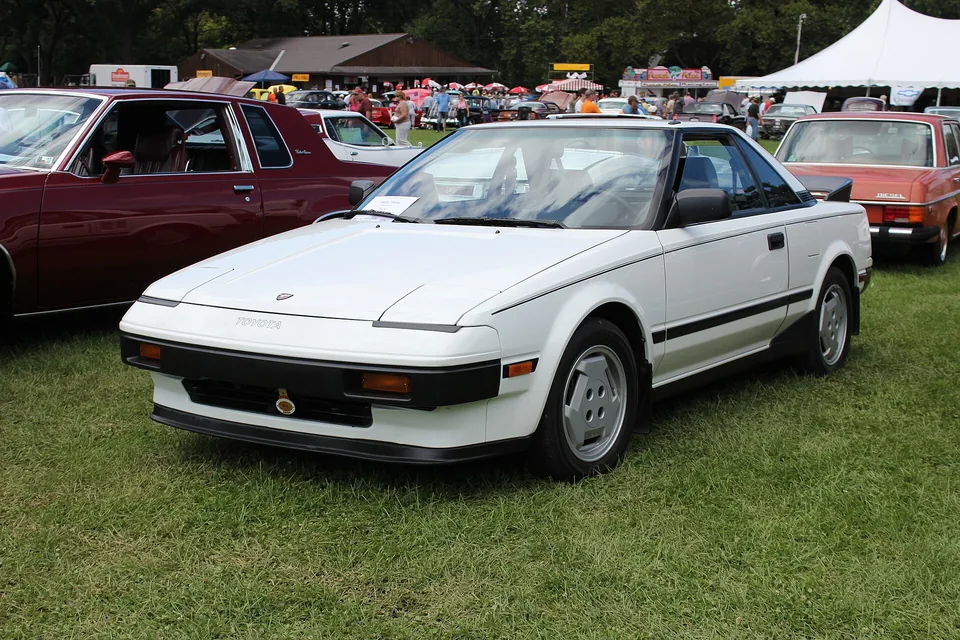
Toyota MR2 (AW11)
Why 6.9: A transverse 4A-GE behind the seats, a five-speed manual, unassisted steering and around a tonne, sold at a price that undercut most front-drive hatchbacks. Toyota developed the suspension with Lotus engineer Roger Becker, and it shows in everything except the way it behaves when you lift mid-corner.
Layout
Natural habitat
Ride comfort
Sound
The same 4A-GE as the AE86, but here it sits behind the bulkhead a hand's width from your ears, so the twin-cam bark past 6,000 rpm arrives with no firewall and no propshaft tunnel to soften it. But it is still 1.6 litres and 128 hp at the very best, all rasp and no bottom end. Placement earns it the two tenths over the Corolla.
4-cylinder · naturally aspirated · 7,500 rpm redline · rated 6.3 / 10 for engine sound
Market value
Median asking price, good condition · €10k (1985) → €17k (2026), trending up · illustrative data
Child seats · ISOFIX
Built before ISOFIX existed, so there are no anchor points at all. A child seat here is a seatbelt installation in the only passenger seat there is.
Derived from production years and seating layout, not a per-car source. ISOFIX was standardised as ISO 13216 in 1997, required on new EU model types from 2011 and on all new EU cars from 2014.
The long version
The MR2 arrived in June 1984 and won Car of the Year Japan on the spot, which for a company whose reputation rested on the Corolla was not a small thing. The recipe is the whole story: take the Corolla's excellent 4A-GE twin-cam, turn it sideways behind the cabin, wrap the lightest possible body around it, and price it as ordinary transport. Toyota did not pretend to know how to make a mid-engined chassis behave and brought in Roger Becker from Lotus to help with the suspension, and the result steers with a directness that survives forty years of comparison. Toyota built 166,104 of them in five years — not a rare car, then or now. America got it as a 1985 model at around $11,000 with a detuned 112 hp engine and rather more kerb weight than the Japanese cars carried, and from 1988 the supercharged 4A-GZE arrived there too, two years after Japan. What has kept this off the collector radar for so long is exactly that volume: they were cheap, they were everywhere, and a whole generation of them were used as first sports cars and thrown away. That has started to change and prices have roughly tripled over a decade, but the AW11 is still the cheapest way into a genuinely good mid-engined chassis, and the people buying them are still driving them.