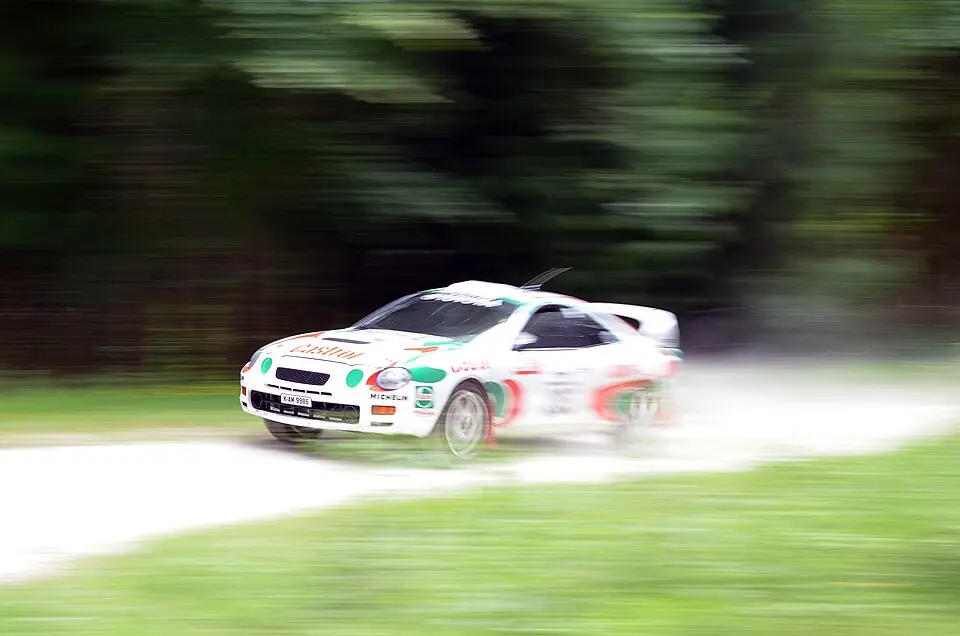
Toyota Celica GT-Four (ST205)
Why 5.3: The homologation special history skips because of how its WRC story ended — a turbo-restrictor scandal and a ban. The road cars soldier on cheaper than any Impreza or Evo of equal pedigree.
Layout
Natural habitat
Ride comfort
Sound
The 3S-GTE gives the flat, hollow woofle of a big-bore four and spools with an audible rush behind it. But it is a single-turbo two-litre buried in a well-insulated coupe on a road-car exhaust. Quieter and duller than the Integrale it was built to chase.
4-cylinder · turbocharged · 7,000 rpm redline · rated 4.8 / 10 for engine sound
Market value
Median asking price, good condition · €11k (2000) → €44k (2026), trending up · illustrative data
Child seats · ISOFIX
Same pre-ISOFIX story for the rear seats — seatbelt-only child restraint, no lower-anchor hardware in any market version.
Sold new in Japan, the UK, continental Europe, and Australia from mid-1994 (not the US) — but production ended in 1999, entirely before ISOFIX existed as factory equipment.
Dual SRS airbags only became standard from August 1996, partway through the production run — earlier ST205s (1994-1996) had no front airbags at all, let alone a child-seat-related cutoff.
Wikipedia Toyota Celica GT-Four (ST205 market launch + August 1996 dual-SRS-airbag running change) (owner-community sourced, not manufacturer documentation)
The long version
The scandal that got Toyota's WRC program disqualified also flattened resale for decades — buyers shopping this against a comparable Impreza or Evo got a real homologation special for a fraction of the money, and a lot of them bought it specifically because the badge on the fender did not carry a collector premium yet. That is starting to change as values catch up to the underlying pedigree, but the current ownership base still skews toward rally enthusiasts who wanted the all-wheel-drive turbo hardware more than the resume. It has aged into the bargain slot its more famous rivals left behind a decade ago.