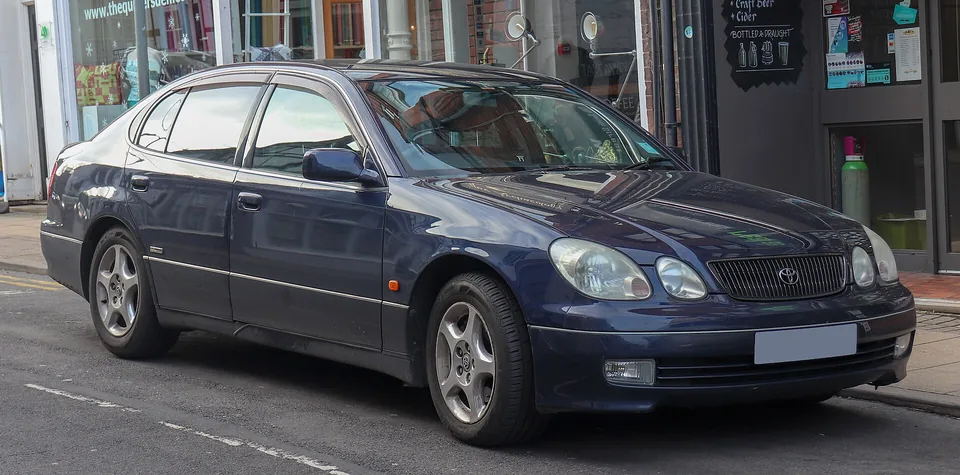
Toyota Aristo V300 (JZS161)
Why 7.6: Outside Japan this car is the Lexus GS, and outside Japan it never got this engine: American GS 300 buyers received the naturally aspirated 2JZ-GE and GS 400 buyers a V8. The JDM V300 has the 2JZ-GTE — twin turbos and 280 PS under the gentlemen’s agreement, with a good deal more underneath it — in a 1,690 kg luxury saloon that is automatic-only and completely anonymous.
Layout
Natural habitat
Ride comfort
Sound
It is a 2JZ-GTE, so there is a dense straight-six pull underneath and a soft twin-turbo swell over it, audibly a larger engine than this class of saloon carries. But Toyota specified the Aristo to be silent at 140 km/h: double glazing, heavy trim, a quiet exhaust. The Supra’s engine, heard through a hotel door.
6-cylinder · turbocharged · 6,800 rpm redline · rated 5.6 / 10 for engine sound
Market value
Median asking price, good condition · €40k (1997) → €22k (2026), trending down · illustrative data
Child seats · ISOFIX
ISOFIX was spreading through these years rather than fitted across the board — whether a given car has rear anchors depends on its year and market.
Children were expected in the back. Front-passenger ISOFIX effectively didn't exist in this era, and airbag deactivation was patchy — treat the front seat as a no unless a specific car proves otherwise.
Derived from production years and seating layout, not a per-car source. ISOFIX was standardised as ISO 13216 in 1997, required on new EU model types from 2011 and on all new EU cars from 2014.
The long version
Toyota’s engine catalogue in the 1990s produced one genuinely famous unit, and the Supra collected the credit for it, but the 2JZ-GTE was never a Supra-only engine. It went into the first Aristo in 1991, eighteen months before the A80 Supra existed, and stayed for the second generation. What makes the JZS161 worth a slot is the shape of what a buyer could and could not have. In America the same car wore a Lexus badge and offered a naturally aspirated straight six or a V8; the twin-turbo was not on the order form in any year. In Japan it was the standard V300 engine. The result is a saloon with leather, climate control, an automatic gearbox and the same iron-block twin-turbo six that made the Supra a legend among people who rebuild engines for a living. Two kinds of buyer followed. One wanted a fast, invisible, indestructible family car and drove it like one, which is why the mileages are high. The other wanted the engine and treated the rest of the car as packaging — a habit that has consumed a large share of the surviving Aristos and is now pushing clean ones up sharply. Neither of those is a flipper. Nobody has ever put an Aristo away for the appreciation.