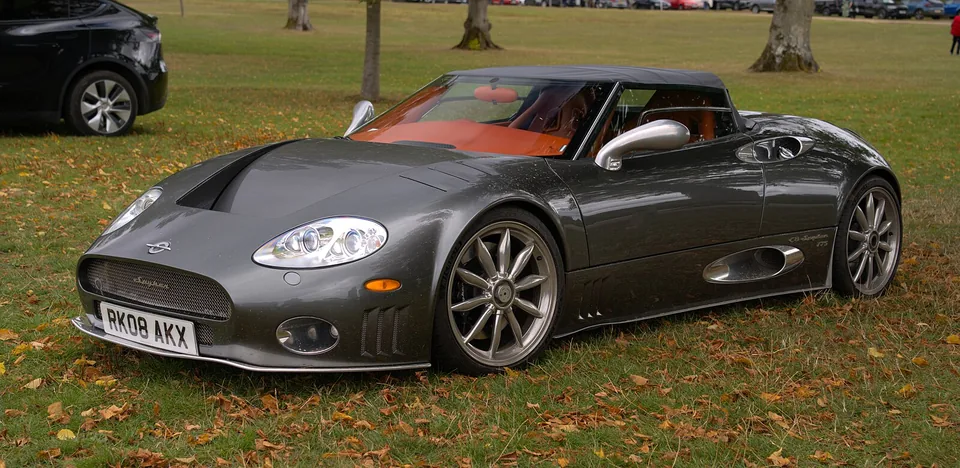
Spyker C8 Spyder
Why 5.0: A Dutch boutique revived a 1900s aircraft-engine marque and built an aluminium-spaceframe roadster where the gear linkage is left exposed on the console because hiding it would be dishonest. Audi supplied the naturally aspirated 4.2 V8; everything visible is Spyker's own obsession.
Layout
Natural habitat
Ride comfort
Sound
Audi's 40-valve 4.2 sits just behind an aluminium bulkhead with no insulation worth the name, and unblown it stays crisp and metallic all the way up — far more urgent here than the same engine ever sounded in an S4. But this is the older 4.2, not the 8,250 rpm FSI from the RS4, so it runs out early and hardens rather than howls.
8-cylinder · naturally aspirated · 7,000 rpm redline · rated 7.8 / 10 for engine sound
Market value
Median asking price, good condition · €216k (2005) → €170k (2026), trending down · illustrative data
Child seats · ISOFIX
There aren't any — strict two-seater.
The only position there is — and the weak point of this era. Airbag cut-off switches only became routine in the mid-2000s; many of these cars have none from the factory, which rules out a rear-facing seat entirely unless a dealer-fitted deactivation was installed. Forward-facing on the belt, seat slid fully back, is what the period manuals allow.
Derived from production years and seating layout, not a per-car source. ISOFIX was standardised as ISO 13216 in 1997, required on new EU model types from 2011 and on all new EU cars from 2014.
The long version
Nulla tenaci invia est via — for the tenacious, no road is impassable — is stamped on the car, which is a lot of confidence for a company that went bankrupt twice. The C8 Spyder is what happens when an industrial designer with an aviation fixation gets to build a supercar without a marketing department: turbine-blade wheels, a propeller motif on the steering wheel, quilted leather everywhere, and that exposed shift mechanism turning every gear change into visible mechanical theatre. Under it sits a 400 PS Audi 4.2 driving through a Getrag six-speed, in 1,275 kg of aluminium, which makes it genuinely quick and — crucially — genuinely serviceable, because the expensive part came from Ingolstadt. That is why this scores highest in the batch. Roughly three hundred C8s of all types exist, they depreciated brutally through the 2010s as Spyker's finances collapsed, and the people who bought them cheap did so because they specifically wanted this car and no other. Values have firmed since — a Laviolette coupe cleared $670,000 recently — but Spyders remain a long way under that, well short of investment territory, and the owners drive them to shows rather than shipping them. Fragile, absurd, and used.