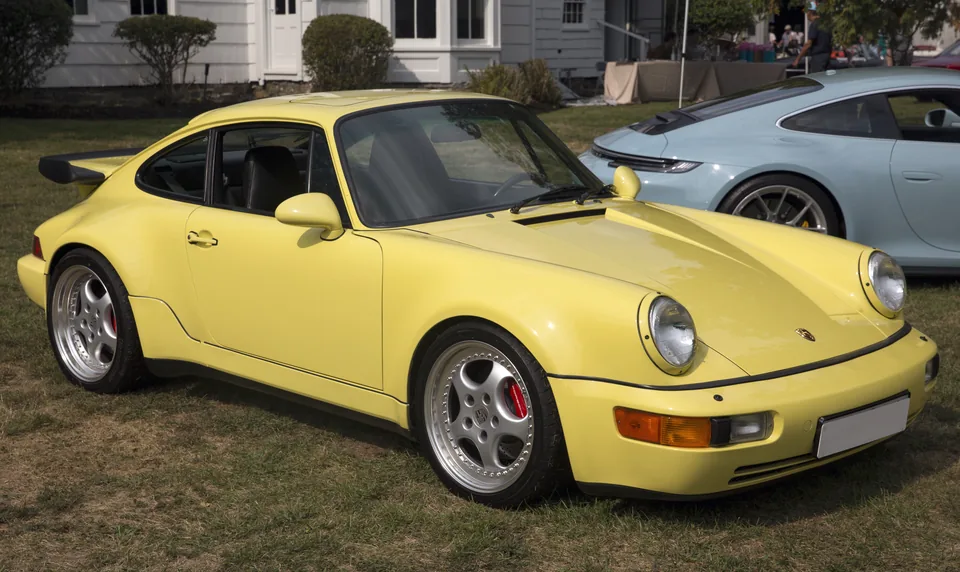
Porsche 911 Turbo (964)
Why 4.3: Porsche did not have the 964's 3.6 ready for boost in 1990, so the Turbo carried over the 930's intercooled 3.3 at 320 hp, with the 964's coil springs, ABS and power steering under the widened body. The 3.6-litre version arrived for 1993 with 360 hp and was built for barely two years; its last 90 chassis became the Turbo S 3.6. Rear-wheel drive and a single large turbocharger: the last 911 Turbo with the old character.
Layout
Natural habitat
Ride comfort
Sound
The 930's intercooled 3.3 single turbo in a 964 shell, so the air-cooled clatter and the big-turbo whoosh are still here, with a louder wastegate from the K27. But a 964 is better insulated than a G-body and catalysts muffle the overrun, so it is a shade quieter than the 930 and short of an NA 964. The last single-turbo 911.
6-cylinder · turbocharged · 6,800 rpm redline · rated 7.2 / 10 for engine sound
Market value
Median asking price, good condition · €87k (1991) → €184k (2026), trending up · illustrative data
Child seats · ISOFIX
Built before ISOFIX existed, so there are no anchor points at all. A child seat here is a seatbelt installation, and the belt geometry of the period was not designed with one in mind.
Derived from production years and seating layout, not a per-car source. ISOFIX was standardised as ISO 13216 in 1997, required on new EU model types from 2011 and on all new EU cars from 2014.
The long version
The 964 Turbo sat in the 930's shadow for twenty years, a 1990s car with a 1970s drivetrain that the air-cooled world considered neither one thing nor the other. Then the market remembered how few were built — around 3,700 of the 3.3 and fewer than 1,500 of the 3.6 — and values roughly tripled between 2013 and 2018. The 3.6 went from a $90,000 car to a $300,000 one and the 3.3 followed at a distance, which moved most of them from the road to the collection. The 3.3 is still used: there are enough of them, and a well-sorted example is a genuinely usable fast car with a 964 interior and 964 brakes. The 3.6 is now a Turbo S-money object that is trailered to events. The score sits between the regularly driven 930 3.3 and the rarely driven 993 Turbo, which is exactly where the car sits in the lineage.