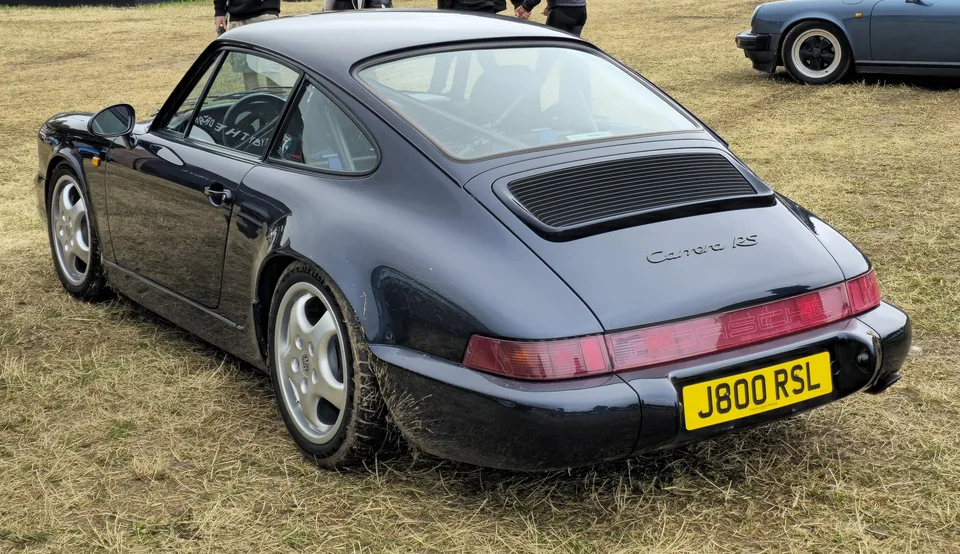
Porsche 911 Carrera RS (964)
Why 3.3: A seam-welded, decontented 964 built off the Carrera Cup car: aluminium bonnet, thinner glass, no power steering, no rear seats, no sound deadening, stiffer and lower on Cup springs, and around 155 kg lighter than the Carrera 2 it came from. Porsche never put it through US homologation, so the American market got the much milder RS America instead.
Layout
Natural habitat
Ride comfort
Sound
A 3.6 flat-six with the insulation deleted, a single-mass flywheel clattering at idle and a lightened shell to resonate through — the loudest air-cooled 911 Porsche sold. It stops short of the GT3s only because 6,800 rpm limits the climb.
6-cylinder · naturally aspirated · 6,800 rpm redline · rated 8.6 / 10 for engine sound
Market value
Median asking price, good condition · €83k (1992) → €350k (2026), trending up · illustrative data
Child seats · ISOFIX
Built before ISOFIX existed, so there are no anchor points at all. A child seat here is a seatbelt installation in the only passenger seat there is.
Derived from production years and seating layout, not a per-car source. ISOFIX was standardised as ISO 13216 in 1997, required on new EU model types from 2011 and on all new EU cars from 2014.
The long version
This is where the modern RS formula actually starts — not the 2.7, which was a homologation exercise in a different era, but the 964, where Porsche worked out that stripping and stiffening a current 911 produced something people would pay a large premium for. The single-mass flywheel and the missing insulation make it genuinely difficult to live with, which is a large part of the appeal and the reason so many now sit still. Values were flat through the 1990s and early 2000s, when this was just an awkward used 911 with no carpet, and then the air-cooled market found it: a good one now costs several times what a standard 964 does. There is still an active minority running them on Tour Auto and classic rallies, which is the only reason the miles number is not lower.