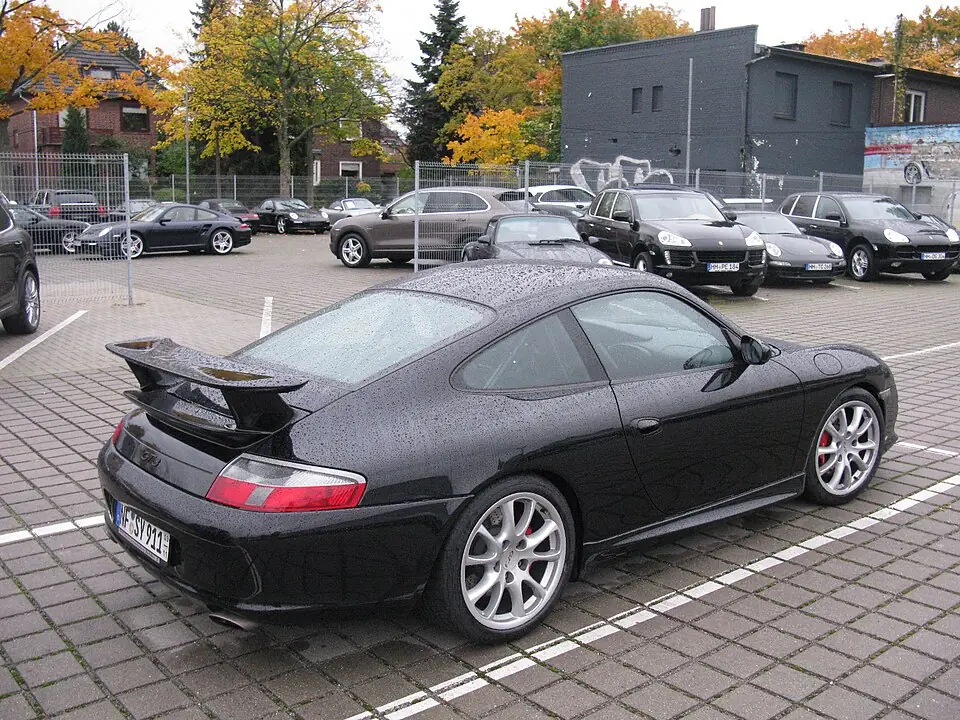
Porsche 911 GT3 (996)
Why 4.8: Porsche never petitioned to federalize the original GT3 — the entire US population is a 25-year-import population, hydraulic steering and no ESC to hide behind. The 2021 speculative spike has already partly corrected; this was built as a Nordschleife tool, not a vault piece.
Layout
Natural habitat
Ride comfort
Sound
The Mezger 3.6 is a racing flat-six with dry-sump plumbing and a dry metallic wail to 7,800 rpm. It sits below the later GT3s only on revs and a tamer exhaust — there is less top end to run through. The point at which the 911 became a noise in its own right.
6-cylinder · naturally aspirated · 7,800 rpm redline · rated 8.6 / 10 for engine sound
Market value
Median asking price, good condition · €77k (2000) → €101k (2026), trending up · illustrative data
Child seats · ISOFIX
There aren't any — strict two-seater.
Same as the GT2 from this generation: standard sport/euro bucket seats that Porsche's rule excludes from child-seat use, plus owner reports of no ISOFIX fitting in 996s generally.
Rennlist 996 GT3 owner reports on euro bucket seats; Porsche Club GB 996 ISOFIX reports (owner-community sourced, not manufacturer documentation)
The long version
This never had a US price sticker, so every example on American roads today arrived either through the 25-year import rule or a lengthy federalization fight, and that filter front-loads the ownership pool toward people who specifically wanted the least-assisted GT3 Porsche ever built. Values spiked hard in 2021 as import eligibility widened and the 'first GT3' story caught on, then started correcting back toward something closer to what the driving experience actually justifies rather than the scarcity premium. What's driving it tends to be exactly who you'd expect: owners who did the import paperwork on purpose, not by accident.