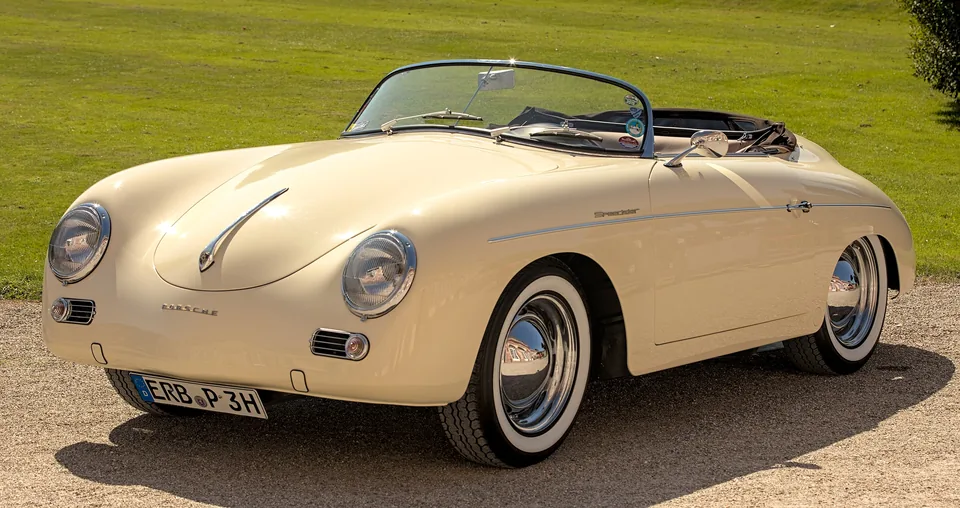
Porsche 356 Speedster
Why 3.8: A 356 with the windscreen cut down, the roof reduced to an apology, roll-up windows replaced by side curtains and the interior stripped to buckets and a rubber mat — around 70 kg lighter than the coupé and built to a price for American club racing. It has no weather protection worth the name and that is the entire design brief.
Layout
Natural habitat
Ride comfort
Sound
A 1.6 pushrod flat-four sitting inches behind an open cockpit with no roof to trap or filter it, giving the full hard air-cooled rasp. But it is seventy-odd horsepower to 5,500 rpm, and the noise never builds into anything.
4-cylinder · naturally aspirated · 5,500 rpm redline · rated 6.0 / 10 for engine sound
Market value
Median asking price, good condition · €3k (1955) → €294k (2026), trending up · illustrative data
Child seats · ISOFIX
Built before ISOFIX existed, so there are no anchor points at all. A child seat here is a seatbelt installation in the only passenger seat there is.
Derived from production years and seating layout, not a per-car source. ISOFIX was standardised as ISO 13216 in 1997, required on new EU model types from 2011 and on all new EU cars from 2014.
The long version
Max Hoffman, Porsche's US importer, told Stuttgart that America would buy a cheap, stripped, sunny-weather 356 to race at weekends, and he was right: the Speedster appeared in 1954 and roughly four thousand were built before the more civilised Convertible D replaced it. The decontenting that made it cheap is exactly what made it collectible, and the trajectory since has been brutal — a car that sold new for under three thousand dollars is now a mid-six-figure concours piece, and the replica industry exists because the real ones left the reach of people who wanted to drive them decades ago. Owners tend to be long-term custodians rather than traders, which keeps the flip number respectable, but a car with no roof and a seven-figure insurance conversation does not get used in November.