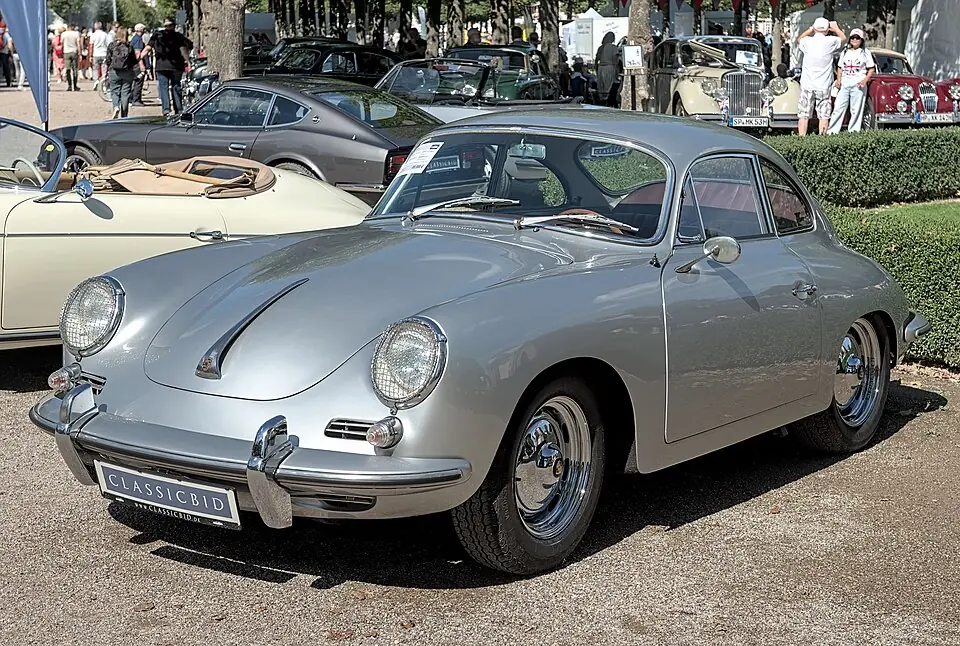
Porsche 356 Coupé
Why 4.8: Sixty horsepower, an air-cooled flat-four, unassisted steering and drum brakes — the origin point for everything the brand still claims about feel over firepower. It asks plenty of a driver despite the modest numbers: swing-axle rear geometry and weak drum brakes reward smoothness and punish anyone leaning on the outright grip a modern chassis would provide.
Layout
Natural habitat
Ride comfort
Sound
The pushrod air-cooled flat-four has the offbeat mechanical patter that made the badge, and with the engine behind you it is always present. But it is a 1.6 revving to 5,000 with Beetle origins, so it putters rather than builds towards anything.
4-cylinder · naturally aspirated · 5,000 rpm redline · rated 5.2 / 10 for engine sound
Market value
Median asking price, good condition · €4k (1960) → €87k (2026), trending up · illustrative data
Child seats · ISOFIX
Built before ISOFIX existed, so there are no anchor points at all. A child seat here is a seatbelt installation, and the belt geometry of the period was not designed with one in mind.
Derived from production years and seating layout, not a per-car source. ISOFIX was standardised as ISO 13216 in 1997, required on new EU model types from 2011 and on all new EU cars from 2014.
The long version
Ferry Porsche built the first examples by hand in a converted sawmill in Gmünd, Austria, before production moved to Zuffenhausen and the model settled into the Pre-A, A, B and C generations that carried it through 1965. Power grew gradually across that run, but the basic formula never changed: light weight standing in for horsepower, a philosophy the 911 inherited wholesale. Decades of steady appreciation have pulled clean coupes out of daily use and into garages, though the car's club culture — rallies, tours, active owners' registries — still gets a meaningful share of the surviving fleet onto real roads.