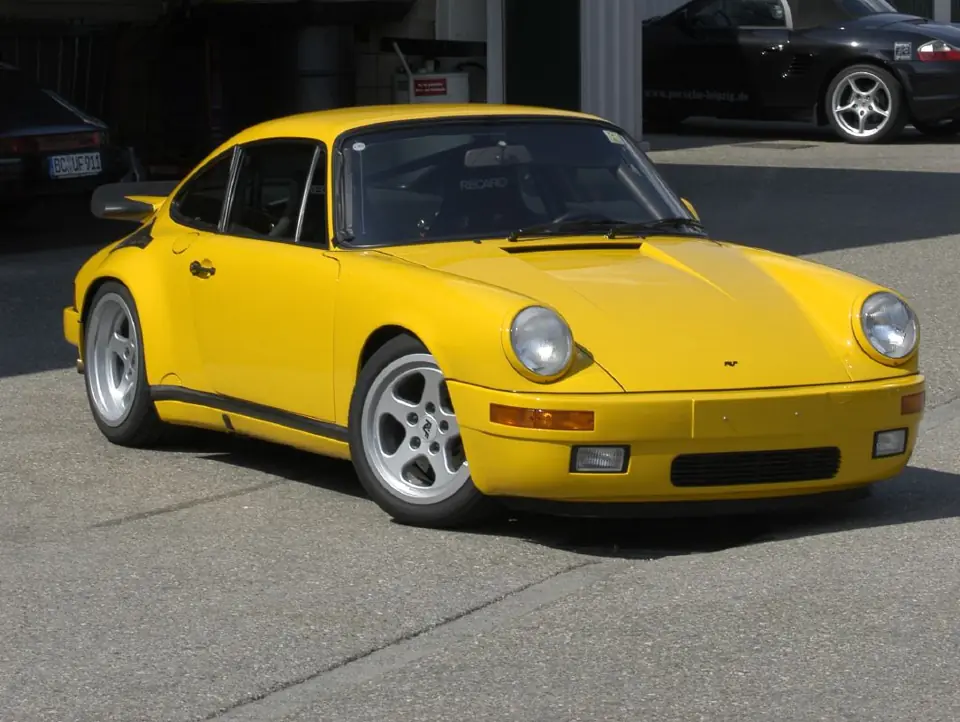
RUF CTR "Yellowbird"
Why 2.5: A twin-turbo flat-six in a narrow-body 930 shell, a 5-speed manual, no ABS and none of the electronic net a modern 911 leans on — about as raw as a road car gets. The 1987 Road & Track top-speed test that made it famous also cemented the widowmaker reputation: massive lag, then a shove few drivers were braced for.
Layout
Natural habitat
Ride comfort
Sound
Air-cooled flat-six clatter overlaid with wastegate chatter and turbo whistle, which is the entire soundtrack of the Nürburgring film and unmistakable for it. But 1980s turbocharging smothers the top end, so it is boost noise more than engine note.
6-cylinder · turbocharged · 6,800 rpm redline · rated 7.6 / 10 for engine sound
Market value
Median asking price, good condition · €136k (1987) → €4.8M (2026), trending up · illustrative data
Child seats · ISOFIX
Built before ISOFIX existed, so there are no anchor points at all. A child seat here is a seatbelt installation, and the belt geometry of the period was not designed with one in mind.
Derived from production years and seating layout, not a per-car source. ISOFIX was standardised as ISO 13216 in 1997, required on new EU model types from 2011 and on all new EU cars from 2014.
The long version
RUF is legally its own manufacturer, not a tuning shop, which is why this car carries its own VIN rather than Porsche's — a distinction the Yellowbird made famous when Road & Track ran it alongside a Ferrari F40, Porsche 959 and Lamborghini Countach in a 1987 top-speed showdown and it came out fastest. That single magazine test turned a small-batch conversion into a legend, and the values followed the legend rather than the production numbers, which were tiny to begin with. What survives now trades as a blue-chip collectible, campaigned occasionally by owners who understand exactly what they're driving.