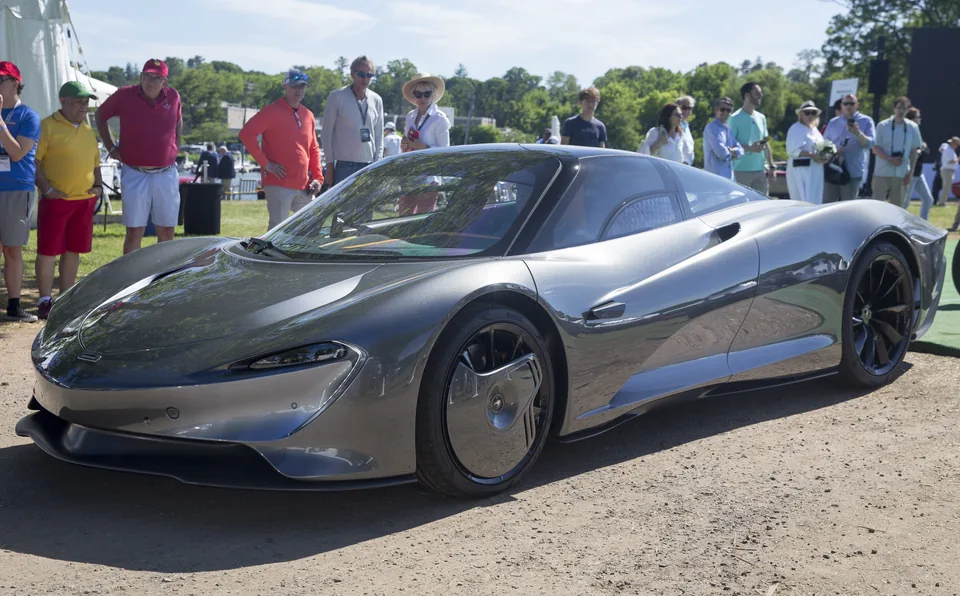
McLaren Speedtail
Why 2.8: A central driving position and 1,036 combined hybrid horsepower built for one number: 250mph, a figure the Speedtail actually hit in testing. McLaren sold all 106 almost entirely to existing Ultimate Series clients — the same closed list that bought the P1 — and the ownership pattern reads the same way: bought for the number, not the commute.
Layout
Natural habitat
Ride comfort
Sound
The 4.0-litre twin-turbo revs to 8,100 rpm and there is a faint hybrid whir layered underneath. But McLaren insulated this one as a grand tourer and the M840 was never tuneful to begin with, so a 250 mph car makes one of the duller noises on the index.
8-cylinder · turbocharged · 8,100 rpm redline · rated 5.7 / 10 for engine sound
Market value
Median asking price, good condition · €2.1M (2020) → €1.9M (2026), trending down · illustrative data
Child seats · ISOFIX
None — the Speedtail repeats the F1's 1+2 layout, driver in the middle.
No ISOFIX. They are fixed, reclined composite seats moulded into the tub, with no anchor provision at all.
McLaren Speedtail 1+2 seating
The long version
McLaren built the Speedtail as a spiritual successor to the F1 — three seats, the driver centered, no rear window, a shape optimized entirely for top speed rather than downforce or lap time. It is, on paper, the least track-focused Ultimate Series car McLaren has built: no fixed wing, no aggressive aero addenda, just a very long, very slippery shape chasing 250mph in a straight line. That mission shows up in how the 106 cars get used — long-distance high-speed runs at best, otherwise a $2.25 million object with an electronically adjustable steering wheel nobody adjusts because nobody drives it enough to need to. Values spiked to $3.3 million at a 2022 auction on hype alone, then slid; recent sales have landed below the original sticker, evidence that even a hybrid hypercar with real performance credentials doesn't automatically hold value once the delivery-mileage premium wears off. The powertrain and chassis underneath are genuinely serious McLaren engineering — related to what makes the 720S and 765LT this index's more-driven McLarens — wrapped in a body built to be looked at more than lived in.