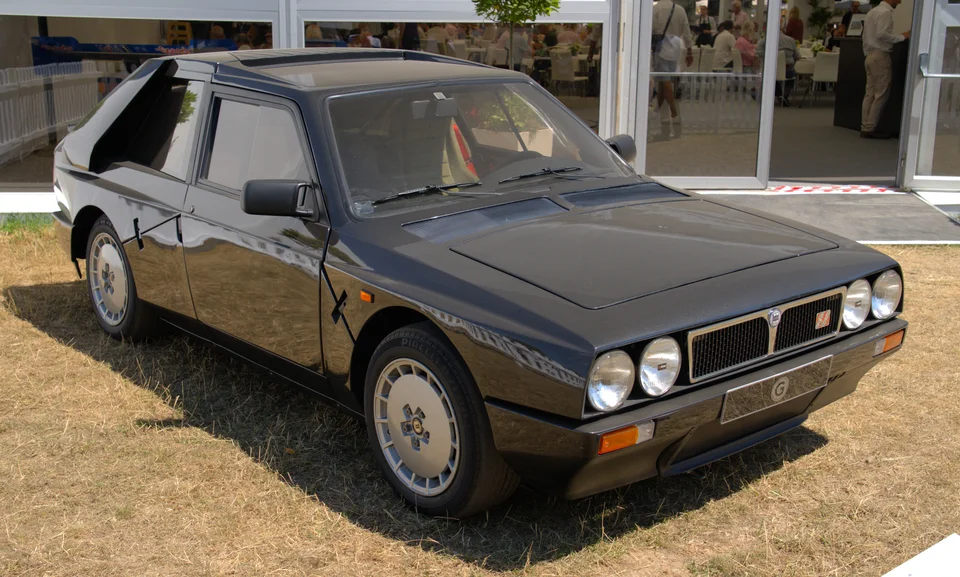
Lancia Delta S4 Stradale
Why 2.5: A 1.8-liter four running both a supercharger and a turbocharger — the supercharger covers the low end and hands off to the turbo once it spools, killing the lag that made every other Group B car a lottery on throttle. The first twincharged production engine ever built. 200 Stradales homologated a rally car so fast it helped end the entire Group B era.
Layout
Natural habitat
Ride comfort
Sound
Supercharger whine and turbo whoosh at once, from an engine sitting centimetres behind the Stradale's bulkhead — a layered noise nothing else on this list produces. But it remains a 1.8-litre four, thrashy rather than tuneful, which caps where it can land.
4-cylinder · turbocharged · 7,000 rpm redline · rated 6.6 / 10 for engine sound
Market value
Median asking price, good condition · €60k (1985) → €1.3M (2026), trending up · illustrative data
Child seats · ISOFIX
Built before ISOFIX existed, so there are no anchor points at all. A child seat here is a seatbelt installation in the only passenger seat there is.
Derived from production years and seating layout, not a per-car source. ISOFIX was standardised as ISO 13216 in 1997, required on new EU model types from 2011 and on all new EU cars from 2014.
The long version
Lancia built the twincharged engine specifically to solve the problem that made Group B cars notorious — turbo lag on a loose surface is how drivers ended up sideways into a tree — by adding a Roots-type supercharger that carries the power delivery until the turbo catches up around 4,500 rpm. It worked: in period, the Delta S4 was one of the most controllable Group B cars to drive at ten-tenths, in the hands of a works driver. The road-going Stradale, built to satisfy the 200-unit homologation minimum, detuned that same engine from the rally car's 480-plus horsepower to a still-serious 247, in a 1,200kg mid-engine AWD shell with none of the electronic safety nets a modern car would carry. Group B was banned at the end of 1986, months after the S4's homologation run finished, following a string of fatal accidents across the category — which makes every surviving Stradale a relic of the exact era that got the whole class killed. That history, combined with genuine rarity, has pushed auction results past a million dollars; a car that traded for used-Golf money in the 1990s now changes hands for more than most houses. Nobody drives a seven-figure Group B homologation special to the shops. What's left gets trailered to concours lawns and the occasional closed-road demo run, not driven the way the works team drove it.