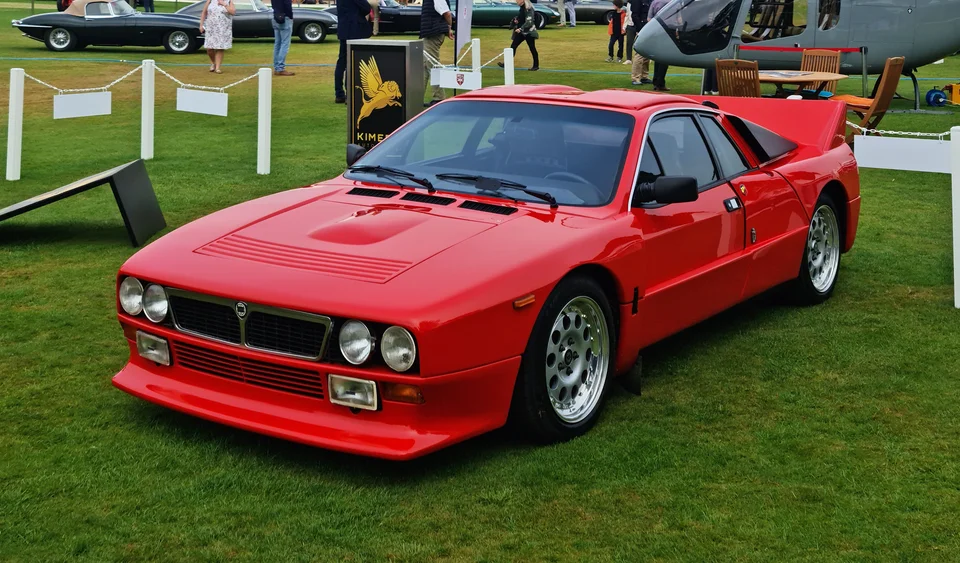
Lancia 037 Stradale
Why 2.8: A supercharged 2.0-liter four, mid-mounted, RWD only — the last car to win the WRC without all-wheel drive, a record that by definition can never be broken. Roughly 200 built to homologate the works rally car; Lancia beat Audi's AWD quattros to the 1983 title on chassis balance alone.
Layout
Natural habitat
Ride comfort
Sound
The Volumex blower sings over an Abarth twin-cam mounted directly behind the seats, with no turbo lag softening either the throttle or the noise. But it is still a 2.0-litre four to 7,000 rpm, so the result is hard and busy rather than rich.
4-cylinder · supercharged · 7,000 rpm redline · rated 6.8 / 10 for engine sound
Market value
Median asking price, good condition · €46k (1982) → €966k (2026), trending up · illustrative data
Child seats · ISOFIX
Built before ISOFIX existed, so there are no anchor points at all. A child seat here is a seatbelt installation in the only passenger seat there is.
Derived from production years and seating layout, not a per-car source. ISOFIX was standardised as ISO 13216 in 1997, required on new EU model types from 2011 and on all new EU cars from 2014.
The long version
By 1982 Lancia could see Audi's quattro coming and knew a conventional RWD car couldn't out-grip it in the wet or on loose gravel, so instead of chasing AWD complexity Lancia leaned into what a lightweight, mid-engined, supercharged car could still do better: change direction. The gamble paid off in 1983, when Lancia beat the AWD Audis to the manufacturers' title — the last time a two-wheel-drive car won the World Rally Championship outright. The Stradale road version that homologated it shares the race car's basic recipe at a fraction of the power, and it drives like exactly what it is: a race car with license plates, twitchy, immediate, and entirely without modern assists. Fewer than a handful were ever sold new in the US, so ownership here is a 25-year-import-rule story from end to end, and the market has recognized the last-of-its-kind narrative hard — auction results have roughly doubled since 2019, with top examples now well past $900,000. At that money the cars that still get trailered to historic rallies are the exception; most sit in climate-controlled storage between concours appearances.