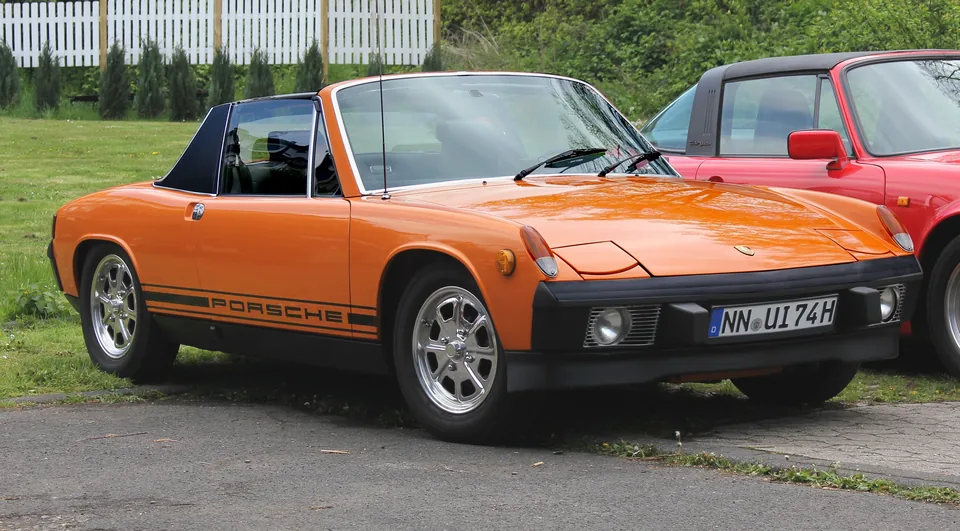
Porsche 914
Why 6.8: Porsche's first mid-engined road car, with the mass between the axles, a removable targa panel and a Volkswagen four making about 100 hp. It has always been slow and it has always handled better than the 911 sold above it, which is precisely the reason it was mocked and precisely the reason it still gets driven.
Layout
Natural habitat
Ride comfort
Sound
The mid-mounted VW Type 4 flat-four sits right behind the bulkhead, so you hear everything it does. Unfortunately what it does is buzz — injected, undersquare and out of puff by 6,000 rpm. The chassis is the reason to own one, not this.
4-cylinder · naturally aspirated · 6,000 rpm redline · rated 4.7 / 10 for engine sound
Market value
Median asking price, good condition · €4k (1970) → €32k (2026), trending up · illustrative data
Child seats · ISOFIX
Built before ISOFIX existed, so there are no anchor points at all. A child seat here is a seatbelt installation in the only passenger seat there is.
Derived from production years and seating layout, not a per-car source. ISOFIX was standardised as ISO 13216 in 1997, required on new EU model types from 2011 and on all new EU cars from 2014.
The long version
The 914 was a joint project with Volkswagen and sold in Europe as a VW-Porsche, a badge that told buyers exactly what to think of it. In the United States it went out purely as a Porsche, became the brand's entry model and its biggest seller, and nearly 119,000 were built before the 924 replaced it. Being the punchline for two generations turned out to be the best thing that could have happened to it: the cars stayed cheap long enough to be used up, modified, autocrossed and club-raced, and the surviving population is dominated by people who understand exactly what they own. Values have finally started moving, but a good 914/4 still costs a fraction of any contemporary 911, and the ownership pattern remains what it has always been — driven, not stored.