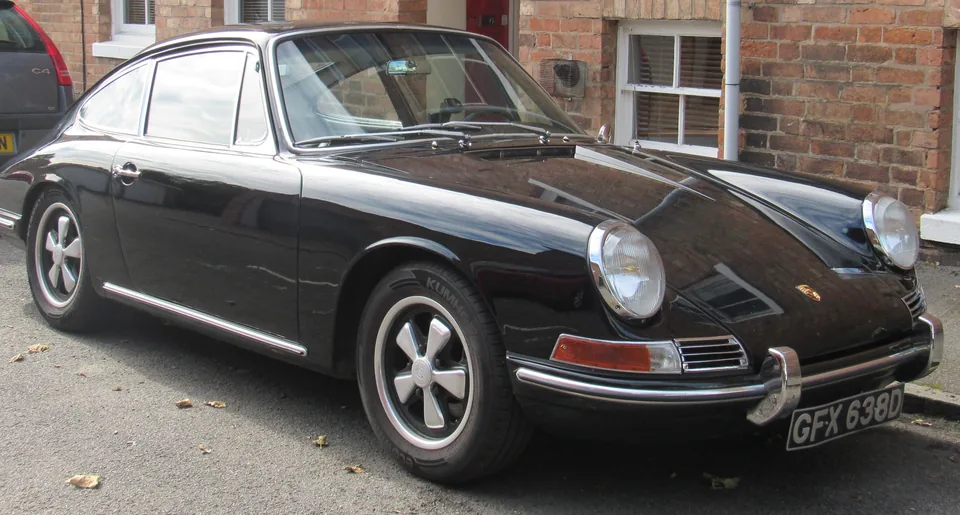
Porsche 912
Why 5.8: Identical body, cabin and unassisted steering to an early 911, with the 356's pushrod flat-four behind the rear axle instead of the flat-six. It cost around a quarter less, outsold the 911 for most of the 1960s, and carries noticeably less mass behind the rear wheels — which is why people who have driven both keep saying the 912 turns in better.
Layout
Natural habitat
Ride comfort
Sound
The 1.6 pushrod flat-four from the 356 has a hard air-cooled thrum and none of the tinniness of the Beetle unit it shares roots with. But four cylinders to 6,000 rpm cannot give the wail the six does. Background noise rather than a reason to buy.
4-cylinder · naturally aspirated · 6,000 rpm redline · rated 5.4 / 10 for engine sound
Market value
Median asking price, good condition · €5k (1965) → €55k (2026), trending up · illustrative data
Child seats · ISOFIX
Built before ISOFIX existed, so there are no anchor points at all. A child seat here is a seatbelt installation, and the belt geometry of the period was not designed with one in mind.
Derived from production years and seating layout, not a per-car source. ISOFIX was standardised as ISO 13216 in 1997, required on new EU model types from 2011 and on all new EU cars from 2014.
The long version
Porsche needed something to sell to the people the 911 had priced out of the 356, so it put the 356 SC's 90 hp four into the new body and charged a fraction less. It worked: more than 30,000 were built between 1965 and 1969, and for four years the cheap one was the volume car. That history is still doing the work today. Long-hood values have climbed hard enough that a matching-numbers 911 of the same age is a preservation project, while a 912 costs less than half as much and gets driven on tours, rallies and club runs by owners who wanted the shape and the feel more than the cylinder count. There was never a speculative spike aimed specifically at the 912 — it rose in the 911's shadow, which is a different thing, and the ownership base still behaves like people who bought a car rather than an asset.