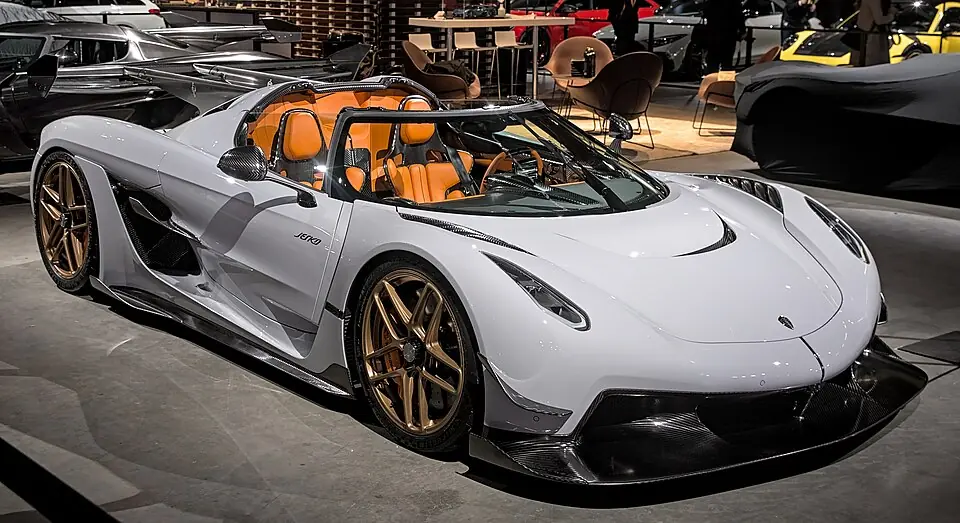
Koenigsegg Jesko
Why 2.8: The Light Speed Transmission is the most interesting gearbox in this batch — nine gears, seven wet clutches, jump-shifting straight to whatever ratio the driver actually wants — and the twin-turbo V8 and chassis match it. It's simply too new and too rare to have built any driving pattern yet.
Layout
Natural habitat
Ride comfort
Sound
Koenigsegg gave it a flat-plane crank and 8,500 rpm, unheard of for a 5.0 twin-turbo V8, so it screams where other blown eights boom. But two large turbochargers still sit between the combustion and the air, keeping it below the unblown exotics.
8-cylinder · turbocharged · 8,500 rpm redline · rated 8.2 / 10 for engine sound
Market value
Median asking price, good condition · €2.8M (2020) → €3.4M (2026), trending up · illustrative data
Child seats · ISOFIX
There aren't any — strict two-seater.
The only position there is, so makers of this era equip it: expect a passenger-airbag cut-off (key switch or occupant sensing) as standard, because there is no rear row to point children to. Whether the seat itself carries ISOFIX anchors is maker-specific — Porsche bundles them with its child-seat preparation, Ferrari sold them as an option, others are belt-mount only with the airbag off.
Derived from production years and seating layout, not a per-car source. ISOFIX was standardised as ISO 13216 in 1997, required on new EU model types from 2011 and on all new EU cars from 2014.
The long version
Koenigsegg sold out all 125 Jesko build slots well before this review, and deliveries are still arriving car by car in 2026, which means almost none of them have enough history yet to show whether Agera-style enthusiast use will repeat. Early signs point the same direction anyway — record-chasing headlines, factory test days, a customer base that overlaps heavily with the marque's existing owners. What little driving has happened favors the same closed-circuit, factory-supervised pattern the brand has always encouraged, insurance and rarity doing the rest of the parking.