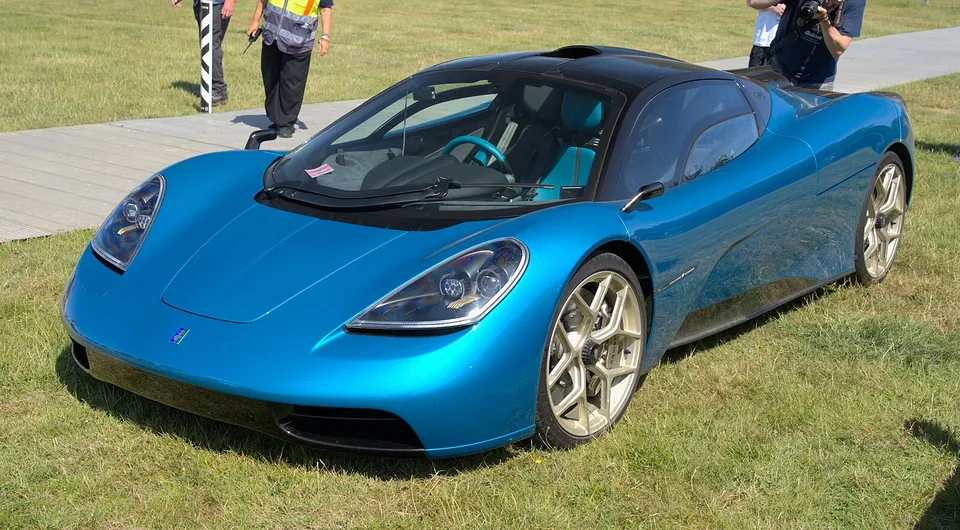
Gordon Murray T.50
Why 4.7: Murray spent thirty years arguing the McLaren F1 had already grown too heavy, then built the correction: 997 kg dry, a central driving seat, a 12,100 rpm Cosworth V12 and an H-pattern manual with no automatic offered at any price. It is the only car in the hypercar wing designed around being used, and the usage data so far agrees — up to a point, because the point is now six million dollars.
Layout
Natural habitat
Ride comfort
Sound
A cold-air ram intake sits directly above the driver's head and the carbon roof panels are shaped as a loudspeaker, so the highest-revving road engine ever built arrives unfiltered at 12,100 rpm. But Murray gated that path to throttle angle, not revs, so it stays civil until asked — theatre on demand, a shade short of the LFA.
12-cylinder · naturally aspirated · 12,100 rpm redline · rated 9.9 / 10 for engine sound
Market value
Median asking price, good condition · €2.8M (2023) → €5.5M (2026), trending up · illustrative data
Child seats · ISOFIX
None — the T.50 repeats the F1's 1+2 layout with the driver in the middle and a passenger set back on each side.
No anchors. They are fixed carbon buckets bonded into the tub, offset behind the driver, with no provision of any kind.
Murray had the whole cabin to redesign and chose three seats and no anchor points, which is a statement about the intended second occupant.
Gordon Murray Automotive T.50 1+2 seating
The long version
The engineering brief reads like a rebuke to everything else on this page. No hybrid system, no dual-clutch gearbox, no launch control, no active aero beyond a 400 mm fan borrowed conceptually from Murray's own Brabham BT46B. The Cosworth GMA V12 weighs 178 kg and revs to 12,100, higher than any road-car engine before it, and it is bolted to a six-speed Xtrac manual because Murray decided early that an automated gearbox would make the car worse to own even if it made it faster. Gordon Murray Automotive delivered all 100 customer cars by 2026 and spent the whole programme talking about luggage space, air conditioning, service intervals and ride quality — the unglamorous things that decide whether a car gets driven or admired. It works. T.50s turn up at Bicester, at Goodwood, at owner drives, on London streets, with mileage on them; almost nothing else at this price does that. The counterweight is arithmetic. A car that listed around $2.9 million has traded past $6 million, and the moment a hundred-unit run starts appreciating that hard, every mile becomes a decision the next buyer will audit. That is the ceiling on its Index score rather than any failure of intent: this is the most driven modern hypercar on the roster, and it still sits below a twenty-year-old Zonda that has had time to accumulate real use.