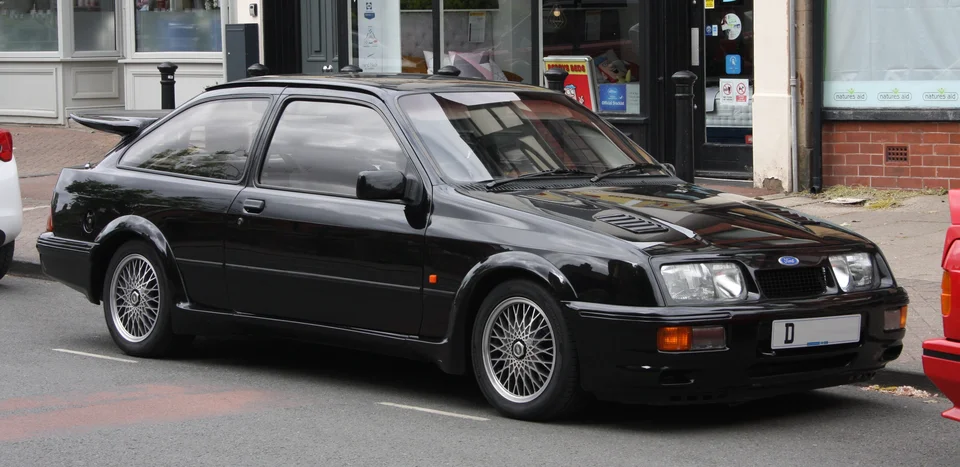
Ford Sierra RS Cosworth
Why 5.8: 224 hp from a 2.0-liter Cosworth-tuned turbo four, RWD, and a whale-tail wing installed to keep the back end planted past 140mph — Ford built this to win Group A touring cars, and 500 RS500-spec homologation cars carried a bigger turbo and extra cooling for tuners to push well past 500 hp in full race trim. It was also, for a stretch in the early 90s, the most-stolen performance car in Britain.
Layout
Natural habitat
Ride comfort
Sound
The YB's dump valve and turbo whistle are the signature sound of a period Group A saloon, and the induction hiss is very present. But underneath sits an ordinary Pinto-derived four with no voice of its own, so this is boost noise rather than an engine note.
4-cylinder · turbocharged · 6,500 rpm redline · rated 5.4 / 10 for engine sound
Market value
Median asking price, good condition · €22k (1987) → €152k (2026), trending up · illustrative data
Child seats · ISOFIX
Built before ISOFIX existed, so there are no anchor points at all. A child seat here is a seatbelt installation, and the belt geometry of the period was not designed with one in mind.
Derived from production years and seating layout, not a per-car source. ISOFIX was standardised as ISO 13216 in 1997, required on new EU model types from 2011 and on all new EU cars from 2014.
The long version
Ford needed 5,000 road cars to homologate a Group A racer that could finally beat BMW and Mercedes in touring cars, and the Sierra Cosworth did exactly that — British Touring Car regulars campaigned it through the late 80s, and the RS500 evolution, a further 500-unit batch with a bigger turbo and extra intercooling built specifically for tuners to exploit, became the dominant Group A car in Europe into the early 90s. On the road it earned a very different reputation: cheap enough for a young driver to actually afford, fast enough to be genuinely dangerous in the wrong hands, and stolen so often that it became a fixture of British crime reporting through the early 90s — several UK police forces ran their own Cosworths as pursuit cars partly because so little else on the road could catch one. That reputation kept prices in the gutter for two decades; good cars traded for used-hatchback money through the 2000s before the market rediscovered what it actually was. An RS500 that would have struggled to find a buyer at ten thousand pounds in 2005 sold for £596,250 in 2023. What's left on the road splits cleanly: high-mileage survivors still get driven and thrashed by owners who bought in before the boom, while recent buyers increasingly treat a good RS500 as a vault asset.