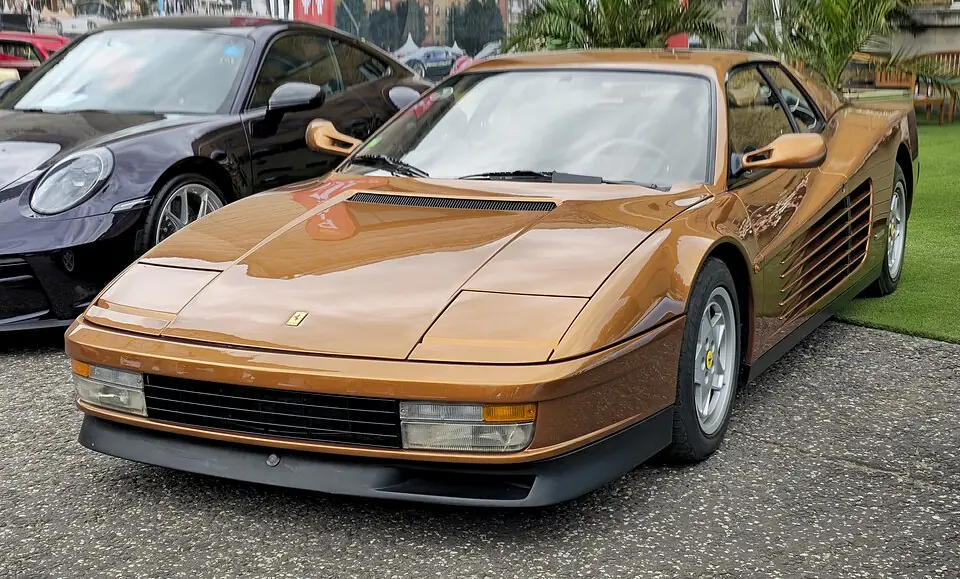
Ferrari Testarossa
Why 4.3: The flat-12 sings to 6,800 rpm and the 5-speed is genuinely good for the era — wide-body drama masks a chassis that's more communicative than its poster-car reputation suggests. Values have roughly tripled since 2015, and low-mileage garage examples now dominate the market over drivers.
Layout
Natural habitat
Ride comfort
Sound
The flat-12 wails hard above 4,000 rpm and no other firing order sounds like it. But Ferrari built this one as a GT — properly insulated, muted below half revs and finished at 6,800 — so it comes across hollow rather than piercing.
12-cylinder · naturally aspirated · 6,800 rpm redline · rated 7.8 / 10 for engine sound
Market value
Median asking price, good condition · €85k (1985) → €161k (2026), trending up · illustrative data
Child seats · ISOFIX
Built before ISOFIX existed, so there are no anchor points at all. A child seat here is a seatbelt installation in the only passenger seat there is.
Derived from production years and seating layout, not a per-car source. ISOFIX was standardised as ISO 13216 in 1997, required on new EU model types from 2011 and on all new EU cars from 2014.
The long version
Big production numbers for an exotic — over 7,000 built — mean this never carried Countach-level scarcity, and for years that kept it as the accessible half of the 1980s poster-car duo, the one people actually bought to drive rather than just display. That's shifting: values have tripled in a decade as the generation that grew up with the poster started buying the real thing, and low-mileage, single-owner cars now command real premiums over drivers. The flat-12 and the cable-operated steering are still there for anyone who wants to use it, which is more than most of its rivals from the era can say.