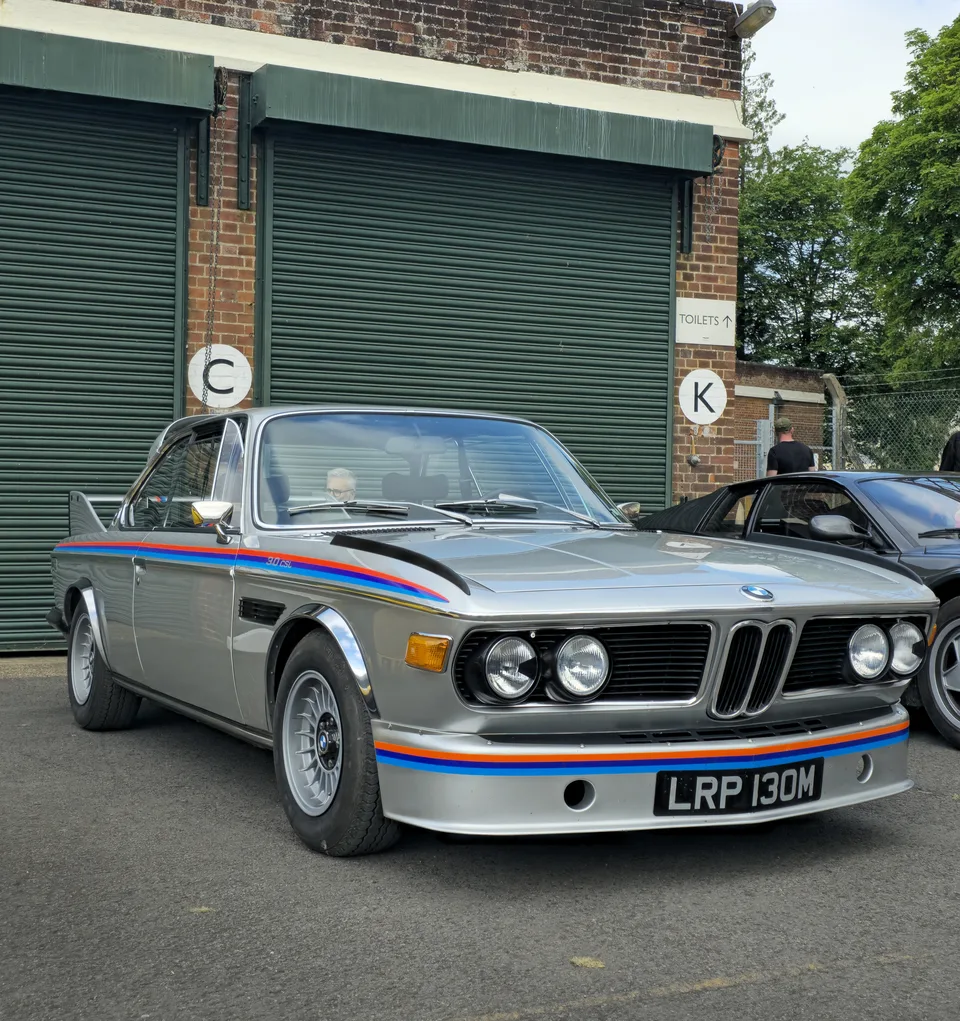
BMW 3.0 CSL
Why 3.3: BMW built barely more than the 1,000-car Group 2 homologation minimum, and the aero package that earned the 'Batmobile' nickname helped a CSL win the European Touring Car Championship in BMW Motorsport's first season, 1973. Values have roughly tripled since 2016, and a six-figure homologation car with grey-market paperwork mostly gets trailered to concours lawns now.
Layout
Natural habitat
Ride comfort
Sound
The M30 straight six is smooth, hard and metallic through a period exhaust, and it is the ancestor of everything an M-badged six did later. But 6,500 rpm and a mild road tune keep the homologation car well short of the racers it existed to legitimise.
6-cylinder · naturally aspirated · 6,500 rpm redline · rated 7.5 / 10 for engine sound
Market value
Median asking price, good condition · €13k (1973) → €386k (2026), trending up · illustrative data
Child seats · ISOFIX
Built before ISOFIX existed, so there are no anchor points at all. A child seat here is a seatbelt installation, and the belt geometry of the period was not designed with one in mind.
Derived from production years and seating layout, not a per-car source. ISOFIX was standardised as ISO 13216 in 1997, required on new EU model types from 2011 and on all new EU cars from 2014.
The long version
Every US example is a grey-market import — BMW never federalized the CSL, let alone the Batmobile aero package added mid-1973 specifically to keep the racing version stable above 200 km/h. That aero kit was so aggressive West German authorities wouldn't approve it for road use either; dealers delivered the wing and front airdam loose in the trunk for owners to bolt on once off public roads. Underneath the fiberglass and Perspex is genuine weight-saving discipline — thinner steel, aluminum doors and decklid, a 4-speed dogleg gearbox shared with the ordinary 3.0 CS — built to clear a 1,000-unit minimum for Group 2 racing, and BMW built just over that, 1,096 road cars. The touring-car pedigree is real and immediate: in BMW Motorsport's first season as a factory division, a CSL won the 1973 European Touring Car Championship manufacturers' title, one of six the model would take through 1979, and a small vintage-racing subculture still campaigns them today. But six-figure values — roughly tripled since 2016, with recent European sales clearing €400,000 — have pushed the road-car population toward storage. The racers still get driven hard; the street cars mostly don't.